AN ONLINE LIBRARY ABOUT MARIJUANA POSSESSION ARRESTS,
RACE AND POLICE POLICY IN NEW YORK CITY AND BEYOND
|
|
AN ONLINE LIBRARY ABOUT MARIJUANA POSSESSION ARRESTS, RACE AND POLICE POLICY IN NEW YORK CITY AND BEYOND |
|---|
_____________________________________________________________________________________________________________________
|
• REPORTS, PUBLICATIONS, TESTIMONY By the Marijuana Arrest Research Project
•
THE SCANDAL OF RACIST MARIJUANA ARRESTS
• STOP & FRISK NYC (news excerpts)
• THE AWFUL SUMMONS COURT SYSTEM IN NYC
NY City's Marijuana Possession Arrests __________________________________ __________________________________
|
STOP AND FRISK NEW YORK
“It is simply fantastic to urge that a [stop and frisk] procedure performed in public by a policeman while the citizen stands helpless, perhaps facing a wall with his hands raised, is a ‘petty indignity.’ It is a serious intrusion upon the sanctity of the person, which may inflict great indignity and arouse strong resentment, and it is not to be undertaken lightly…. Even a limited search of the outer clothing for weapons constitutes a severe, though brief, intrusion upon cherished personal security, and it must surely be an annoying, frightening, and perhaps humiliating experience.” – Supreme Court Chief Justice Earl Warren, Terry v. Ohio, 1968 _______________________________________________________________________________________
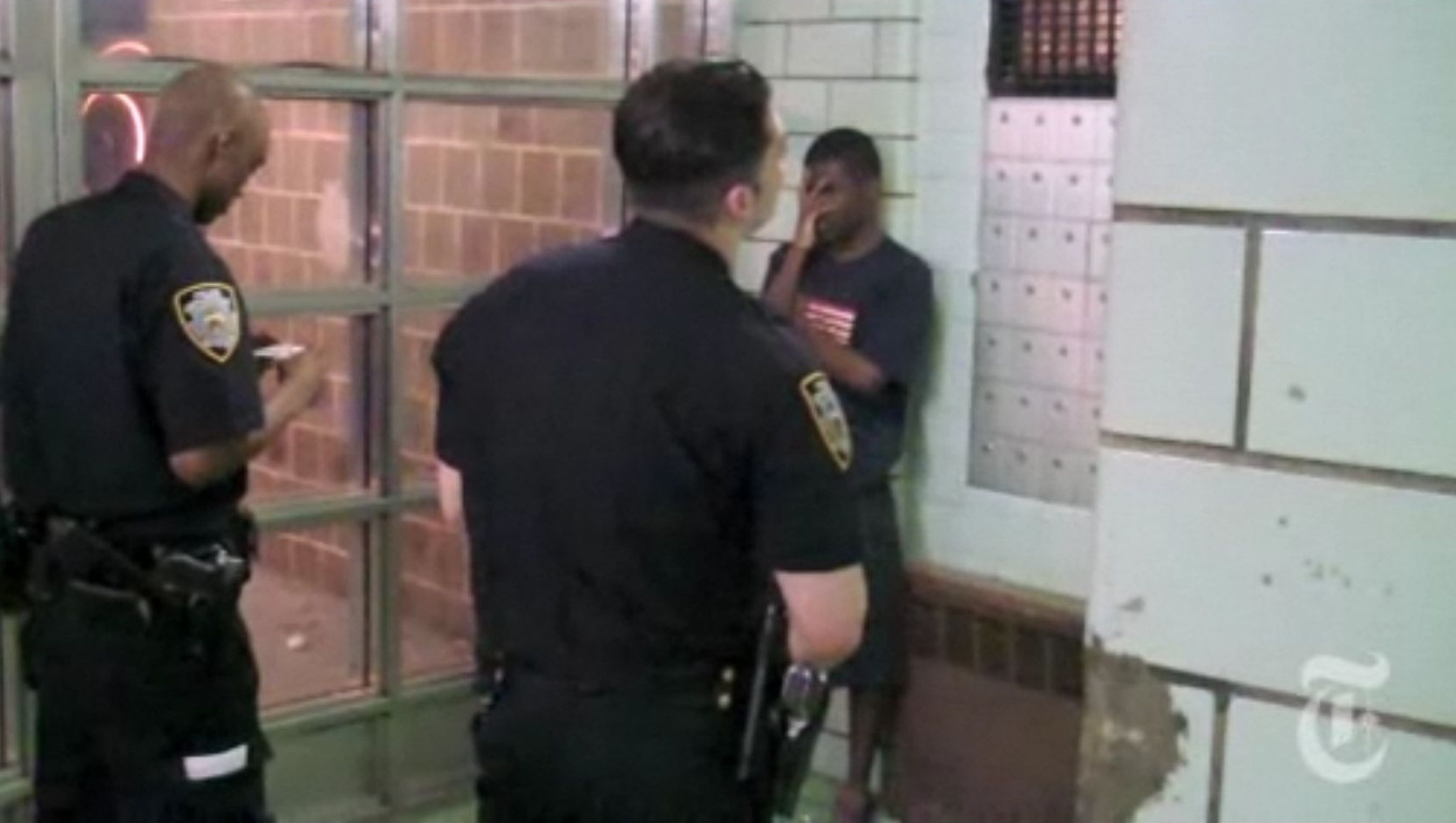
Frisk and search of pockets in Brooklyn, April 2011
__________________________________________________________________________________________
_____________________________________________________________________________________
EXCERPTS FROM MAJOR NEWS STORIES AND COMMENTARY ABOUT NEW YORK CITY'S ENORMOUS STOP AND FRISK CAMPAIGN AND THE OPPOSITION TO IT FROM 1999 TO FLOYD TRIAL IN 2013 ________________________________________________________________________________________
Intro from the summer of 2013:
In Mayor Bloomberg's third term (2010-2013) the NYPD has averaged over 600,000 recorded stop and frisks where police officers filled out what the NYPD calls "UF-250" forms. At the same time, the police department also made an unknown number of stops, frisks and searches, possibly hundreds of thousands more, in which UF-250 forms were not filled out. The numbers of reported and unreported stop and frisks have been increasing since the 1990s prompting multiple lawsuits, an investigation and report by the NY state attorney general, protests, lengthy academic and research studies, strongly critical newspaper columns, and many news stories. Yet the mayor and his police commissioner go on, targeting mainly teenagers and young men, nearly 90% of whom are blacks and Latinos.
As the following excerpts note in passing, the stops often include a search of the person's clothing and possessions. Although it is rarely discussed, most such searches inside of pockets, clothing and possessions are illegal and unconstitutional.
As everyone including Governor Cuomo now say, the marijuana possession arrests are a direct product of the stop and frisks. In 2012 the stop and frisks were down 22%. In 2012, the marijuana possession arrests were down ... 22%. Despite Governor Cuomo's push for decriminalization to stop the marijuana arrests, and the support of all five NYC district attorneys and much of the legislature, it may not be possible to end the marijuana arrests without seriously altering the stop and frisks. And Bloomberg and Kelly may stall that change until the next mayor takes over in 2014. We will see..... [written in the summer of 2013] _______________________________________________________________________________________________
Stop and Frisks Trial in Floyd case, Judge Scheindlin and more
Center for
Constitutional Rights law suit against the NYPD's Stop and Frisks, Floyd, et
al. v. City of New York.
New York
Daily News Articles about the 'Floyd' trial and more
"Orwellian Law Enforcement:
Police 'Stop and Frisk' Detentions in New York City" by By Li Onesto, March
27, 2013
But that claim is being challenged in Floyd v. the City of New York, a federal class-action trial in Manhattan, where witnesses including police officers are arguing that the department does, in fact, use race as the basis for stopping and frisking hundreds of thousands of citizens a year. This week, the court heard a troubling recording secretly made last month by Officer Pedro Serrano, of the 40th Precinct, in the South Bronx. Mr. Serrano is one of a handful of officers who began tape-recording conversations with their colleagues or superiors to document what they saw as wrongdoing. In the recording, Deputy Inspector Christopher McCormack is heard urging Mr. Serrano to stop, question and, if necessary, frisk “the right people at the right time, the right location.” When Mr. Serrano asked for clarification about who the “right people” were, the inspector replied: “The problem was, what, male blacks.” He continued, “And I told you at roll call, and I have no problem telling you this, male blacks 14 to 20, 21.” On its face, this would seem to violate the Fourth Amendment, which protects citizens against unlawful search and seizure. Police officers can legally stop and detain a person only when they have a reasonable suspicion that the person is committing, has committed or is about to commit a crime. The trial court also heard this week from Officer Adhyl Polanco of the 41st Precinct, who had taped proceedings in his station house. Mr. Polanco testified that officers were subject to a quota system, which required them to write more summonses, make more arrests and create stop-and-frisk encounters. He said that his superiors wanted “20 summons and one arrest per month.” The plaintiffs argue that a quota system put officers under pressure to make unconstitutional stops.
The trial is expected to last six weeks. But the
testimony has already pointed to disturbing conduct by the police command
and a profound indifference to the constitutional rights of the city’s
citizens.
"Momentum Surges For Police Reform," By Natasha Lennard, Salon, March 20,
2013 NYC Politicians Push For A Police Watchdog. A Federal Judge
Examines Stop And Frisk.
"NYPD Stop-And-Frisk Lawsuit Starts 'Trial Of The Century,' Lawyer Says" by
Matt Sledge, Huffington Post, March 13, 2013
Judge To Weigh Ny Police Tactics In Bronx Housing Case, Basil Katz, Reuters, November 7, 2012 NEW YORK (Reuters) - A civil liberties lawyer on Wednesday asked a U.S. judge to force the New York Police Department to develop and implement clear policies on how it stops people in and around certain buildings in the borough of the Bronx. The request capped seven days of testimony before U.S. District Judge Shira Scheindlin in Manhattan, in one of three main lawsuits challenging aspects of New York City's controversial "stop and frisk" crime-fighting tactics. In the Bronx case, the New York Civil Liberties Union and 12 plaintiffs have asked Scheindlin for a preliminary injunction against aspects of "Operation Clean Halls," a citywide police patrol program inside and around private, mostly low-income housing buildings that opt to enroll. In his closing argument Wednesday, NYCLU attorney Christopher Dunn asked the judge to compel the city to improve oversight of the police so that stops of people suspected of criminal trespass outside a "Clean Halls" property are made with reasonable suspicion. "We want a real, specific department policy and procedure that spells out how and why a person can be stopped outside 'Clean Halls' buildings," Dunn said. Dunn also asked the judge to order new training and accountability measures.... The NYCLU argues that last year, 1,137 of 1,857 stops in the Bronx of people suspected of criminal trespass outside "Clean Halls" properties were made without reasonable suspicion and were potentially unlawful.... Over the course of the seven-day bench trial, the judge heard testimony from high-ranking police officials, individual plaintiffs and expert witnesses. Scheindlin on Wednesday said she would rule only after reviewing additional written briefs to be submitted later this month. In a ruling last month allowing another stop-and-frisk lawsuit to proceed to trial, Scheindlin said that case involved "matters of grave public concern." She also questioned whether police, in their zeal to keep housing residents safe, were violating the rights of the same people they were seeking to protect.
The case is Jaenean Ligon et al v City of New York,
U.S. District Court, Southern District of New York, no. 12-cv-2274. Momentum Builds in the Fight Against Stop-and-Frisk, by Christie Thompson, The Nation, October 31, 2012 http://www.thenation.com/article/170944/momentum-builds-fight-against-stop-and-frisk New York City Council member Deborah Rose adjourned a three-and-a-half-hour evening hearing on stop-and-frisk with a word of advice: “Be safe traveling home,” she said. “Avoid the police.” There seemed little else to say, now that Rose and the packed room of hearing attendees had heard nearly thirty testimonies of abuse and harassment at the hands of the New York City Police Department. Among others, Rose heard from a Bangladeshi teenager who was patted down by two male police officers looking for marijuana on her way to school, a mother who was beaten by police in front of her home for having a closed bottle of alcohol, and a civil rights activist who was thrown against a wall and frisked during an afternoon smoke break outside his Manhattan office. The city council hearings in Brooklyn and Queens last week provided a forum for roughly sixty community members to share their stories and speak out on stop-and-frisk. Between the two hearings, all but one of the testimonies offered emphatically opposed the practice. Many who spoke called for support of the Community Safety Act, legislation that would increase oversight of a police department now operating with near complete autonomy. Momentum has been building in the community effort against stop and frisk. On October 22, activists gathered for the National Day of Protest to Stop Police Brutality, many marching in memory of those killed by police shootings. As city council considers the Community Safety Act, organizers have been increasing pressure on local legislators to address the current impunity of the NYPD. The City Council’s public safety committee first held a hearing on the Community Safety Act in Manhattan at 10am on Wednesday, October 10, but few from the communities most impacted by stop-and-frisk were able to attend. “Their voice needed to be a part of the record,” said council member Rose. “We are hearing from the so-called experts, but we haven’t had the personal testimonials.” The hearings were the first opportunity many community members had to share with city officials their stories of mistreatment by the NYPD. Fifteen-year-old Ceiro De Jesus from the Bronx was one of the youngest to speak in Brooklyn. He and a group of friends were playing football at a neighborhood park on a Saturday afternoon, when two white police officers parked next to the field and ordered them to put their hands up. When De Jesus asked why they were being frisked, the cop answered, “Because you’re young, out of control and colored . now get your ass home before you learn how it is to be in jail.” De Jesus told his mother, but her advice was the same as council member Rose’s: watch out for cops. He and his friends have stopped going to the park, and mostly stay indoors. “Ever since that day, I feel like I have no freedom,” he said. Several former NYPD officers also spoke out against the number-driven system pushing police to make random stops. “Our community is under siege,” said retired officer Howard Henderson in Queens. “There is profiling and there [are] quotas. In this community, there’s a quota of one arrest and thirty summons in a month. Certain communities [in] the city do not have quotas. In these communities, the minority communities, they definitely do.” Missing from both the Brooklyn and Queens hearings were representatives of the Mayor’s office or the NYPD. (Bloomberg sent his lawyer Michael Best to attend the October 10 hearing, but NYPD has not had an official representative at any of the stop-and-frisk hearings.) Both Mayor Bloomberg and Police Commissioner Raymond Kelley have been highly defensive about the program. While they admit that individual abuses of power need to be addressed, they continue to claim that the tactic at its core is making New York City streets safer. They have repeatedly claimed that gun violence has decreased as a result, though a gun was recovered [4] in roughly .001 percent of the 685,724 stops conducted in 2011..... The proposed legislation would prohibit officers from using racial profiling as a police tactic, and make them accountable for policies that have a disproportionate racial impact, such as stop-and-frisk. It also broadens the ban on profiling to include targeting individuals based on ethnicity, religion, sexuality, and housing and immigration status. During a stop, officers would have to identify themselves and cite a reason for the stop. Though NYPD would still be allowed to perform pat-downs, they would have to explain the individual’s right to refuse a search of their pockets and belongings without a warrant. Most importantly, Bill 881 of the act calls for the creation of an Inspector General’s office to perform routine reviews of NYPD policies. “The number of New Yorkers who believe the problem is a systemic lack of oversight leading to a culture with no accountability is growing,” said council member Brad Lander, a vocal supporter of the act. The FBI, CIA and police departments in Los Angeles, Chicago and DC all have independent oversight. The NYPD is one of the few city departments not subject to such review.
It is not just black and Latino communities calling
for the passage of protections that heighten police accountability. Several
activists also testified on the need for deeper investigation into the
department’s anti-terrorism efforts, which regularly sends informants into
Muslim neighborhoods. “We’re not being thrown up against walls, we’re being
spied on,” said Linda Sarsour, director of the Arab American Association in
New York. Recognizing the links between stop-and-frisk and police
surveillance, the Muslim American Civil Liberties Coalition has joined with
Communities United for Police Reform to advocate for the new legislation.
“At the end of the day, it’s about discriminatory policies of the NYPD. The
more communities involved the more effective we will be at reforming it,”
she said.
NY City Council hears testimonies against NYPD Stop, Question & Frisk, By Karen Clements, Examiner.com, October 25, 2012 http://www.examiner.com/article/ny-city-council-hears-testimonies-against-nypd-stop-question-frisk They lined up last night to give their testimony on their experience with the NYPD practice of stop and frisk. They represented a broad spectrum from teens and seniors to those with kufis to others with clean shaven heads. They were parents, civic leaders and victims of the stop and frisk policy. It was the New York City Council Committee on Civil Rights public hearing at York College on the New York Police Department’s use of stop, question and frisk. There was a similar hearing the previous day in Brooklyn. The hearing was an attempt to capture stories from the public on the record in an effort to “further bolster our efforts to reform stop, question and frisk,” said Committee chair Councilwoman Deborah Rose. She called the policy “one of the most pressing civil rights issues of the time”. Brought up in groups of four, speakers were given a time limit of three minutes but dropped down to two when the long line of people for testimony was assessed. Some of the testimonies were personal and often times the speakers would run over the limit with a tale too compelling to interrupt. Marlon Castro was subjected to homophobic slander during his stop. “You AIDS infested faggot,” was the term Marlon says the cop used when he was stopped. Manny, a 14 year old Bangladesh teen and resident of Jamaica, has been stopped on the way home from school. She believes the stops are because of her “darker skin,” she said. “They treat us like we are already guilty,” she said. Current and retired police officers placed their testimony on the record telling their tales of retaliation for pushing back against the policy. In one of the rare editorial moments of the hearing, Councilwoman Rose extended her apologies for the retribution that Officer Polanco spoke of at his turn at the microphone during his tenure. She also thanked Howard Henderson, a retired police officer, who spoke of productivity quotas police had to make in certain areas. “Thank you for vindicating me,” she said on the issue. And throughout the night, the support of police while condemning the policy was evident. Councilman Jumaane Williams, a co-sponsor of the hearing, acknowledged the police that risk their lives daily for our safety in his closing remarks. But it was also evident that there is a disdain for the Police Commissioner and Mayor. “If the Commissioner and the Mayor refuse to engage in this conversation they are continually and increasingly putting this city in danger” Councilman Williams said in his closing remarks. “We are making every effort to make changes”, said Council Woman Rose during her remarks. She said the Council had been “stymied by Commissioner Kelly” calling the action “blatantly disrespectful”.
Civic and community leaders from the Southeast
Queens also took their turn at the microphone in their support for reform
and oversight. Donovan Richards, Chief of Staff to Councilman Sanders, said
“we can no longer afford to do nothing”. Leroy Gadsden, President of the
Jamaica Branch NAACP, spoke about how the NYPD is out of control and called
the policy “racial profiling”.... The standing room only attendance
also included various community and civic leaders.
Report: Cops more likely to harass non-white LGBTs, by Clare Trapasso, New York Daily News, October 25, 2012 Black and Hispanic gays and lesbians in Jackson Heights are more likely to be harassed by cops than their straight peers — especially during stop and frisks, a new report claims. The Make the Road New York report, released Tuesday, also alleges that transgender women are particularly vulnerable to being arrested and charged with prostitution — often without cause. “When (lesbian, gay, bisexual and transgender) people are stopped and frisked, it’s a very different experience from when heterosexual people are stopped,” said Karina Claudio-Betancourt, who runs Make the Road’s LGBTQ Justice Project. “They are usually verbally (and) physically harassed.” Her group, along with various elected officials, is trying to pass the Community Safety Act, which would limit racial profiling in stop and frisks and require cops to get consent before searching anyone. “Stop and frisk is a huge problem,” said City Councilman Daniel Dromm (D-Jackson Heights). “People are degraded; they’re embarrassed.” Almost 29,000 people were stopped and frisked in 2011 in the 110th and 115th precincts, which cover Jackson Heights, Corona and Elmhurst, according to the New York Civil Liberties Union.
Of LGBT respondents surveyed in the Make the Road NY
report, 51% reported that they had been harassed when stopped by police.
Only a third of straight respondents said the same. The report surveyed more
than 300 people in total.
Stop and Frisk Comes Under Fire at Public Hearing, By Kathleen Horan, WNYC. October 23, 2012 http://www.wnyc.org/blogs/wnyc-news-blog/2012/oct/23/stop-and-frisk-comes-under-fire-public-hearing/ More than 300 New Yorkers showed up to express their feelings on the controversial police tactic of stop-and-frisk at a City Council Civil Rights Committee hearing Tuesday night. The committee heard passionate first hand testimony about what it's like to be stopped by the police, and many said the fear of being stopped and possibly arrested is persistent.
East New York resident Romale Johnson, 21, said he's
been stopped and frisked about 20 times in the last five years.
Trespassing in Your Own Home, Editorial, New York Times, October 22, 2012 http://www.nytimes.com/2012/10/23/opinion/trespassing-in-your-own-home.html District attorney’s offices in New York City have generally supported the Police Department — or kept quiet about their reservations — during the escalating battle over the department’s stop-and-frisk program, under which hundreds of thousands of citizens are stopped every year, often for no reason. But a hearing under way in Federal District Court in Manhattan is featuring an open and fiery dispute between the Police Department and an assistant district attorney from the Bronx, who has testified that her office began to have misgivings about the legality of some trespassing arrests as far back as five years ago. The federal lawsuit, Ligon v. City of New York, was brought on behalf of people who say they were illegally stopped, given tickets or arrested on trespassing charges in apartment buildings, some in buildings where they lived. The suit focuses on the city’s two-decade-old “Clean Halls” program, under which police officers patrol private buildings with the permission of landlords. Jeannette Rucker, a veteran prosecutor, recounted that her office began to have questions about many of the Police Department’s trespassing arrests in the past several years. She said Bronx judges “just started dismissing these cases left and right” because they believed that the officers had no legitimate legal reason for approaching the people who had been arrested — sometimes merely because they had been seen entering or leaving a Clean Halls building. Her staff also told her that judges were throwing out cases because the police had charged people with trespassing in their own buildings.
In a memo in April 2009, Ms. Rucker notified the
Police Department that trespassing cases had become “problematic for the
district attorney’s office” because judges were dismissing them for
insufficient cause. The memo cautioned officers to check to establish
people’s residency and to determine whether they were legitimate visitors. Last year, the Bronx district attorney’s office issued another memo to the police, noting that courts had held that a person who merely exited a Clean Halls building could not be legally stopped unless the officer had a clear reason to suspect criminality. This summer, Ms. Rucker notified the Police Department that her office would no longer prosecute Clean Halls or public housing trespassing cases based on paperwork and would require that officers be interviewed.
The case could potentially go into next year. But
the prosecutor’s testimony is strong evidence of the program’s problems and
the Police Department’s failure to protect people’s constitutional rights.
Prosecutor Testifies on Stop-and-Frisk Tactics, By Joseph Goldstein, New York Times, October 15, 2012 As a federal court hearing began on Monday in a critical challenge to New York City’s use of stop-and-frisk tactics, a Bronx prosecutor testified that she believed the police were wrongly stopping and arresting innocent people for trespassing. The testimony of the prosecutor, Assistant District Attorney Jeannette M. Rucker, came as the hearing opened in Federal District Court in Manhattan, the first court proceeding in which a federal judge is expected to rule whether the Police Department has engaged in a pattern of unconstitutional stops under Mayor Michael R. Bloomberg’s administration. The hearing is expected to feature testimony over two weeks from numerous people who say they were improperly stopped, as well as from several of the department’s highest ranking officials, including Chief of Patrol James Hall. The police witnesses are expected to defend the stops as both legal and necessary and to explain the legal training that officers receive. On Monday, Ms. Rucker spoke about the concerns that led her in July to send a letter to the Police Department alleging that officers were engaging in wrongful arrests. Ms. Rucker, who runs the complaint room, where charges are drawn up against defendants, testified that she had grown concerned over the legality of some trespass arrests after noticing that judges had “started dismissing these cases right and left.” Soon, she explained in testimony, her staff of prosecutors began telling her that they had found instances in which the defendants lived in the very buildings where the arrests occurred. “O.K., this seems to be a problem,” Ms. Rucker said, recalling her thinking. She said she later received an anonymous letter from a person claiming to have been arrested on trespassing charges while leaving a building with a friend who lived there. She forwarded it to other senior prosecutors in the Bronx, adding her own note. “I said, ‘Enough is enough, we have to stop this,’ ” Ms. Rucker recounted. Ms. Rucker explained that in one instance an assistant district attorney, David Grigoryan, went to the building where a trespass arrest occurred, where he spoke with a guard and learned that the defendant “lived in the building with his sister.”
That case, Ms. Rucker testified, “really pushed me
over the edge.” In July, she sent a brief letter to numerous police
officials outlining her concerns and announcing this change in policy: From
then on her office would prosecute trespass arrests only after interviewing
the arresting officer. Previously, prosecutors went forward with a case
simply on the basis of the paperwork the officer filled out.
New York City Council Seeks to Limit Police Stop-and-Frisks, By Henry Goldman, Bloomberg.com, Oct 10, 2012 The New York Police Department’s stop-and-frisk policy came under attack from city council members considering four laws that would restrict the encounters and create an inspector general to monitor the practices. Police stopped 685,724 people they deemed suspicious on streets in 2011, of whom 84 percent were black or Hispanic, according to the Center for Constitutional Rights, a New York- based nonprofit that in 2008 filed a federal civil-rights suit in Manhattan against the NYPD over the tactic. “It’s despicable, totally unacceptable and it should not be tolerated by the NYPD,” Harlem Councilman Robert Jackson told Michael Best, counsel to Mayor Michael Bloomberg, who opposes the bills. “It needs to be totally revamped and it needs to be done now.” About 200 people packed the council’s City Hall chambers today for the hearing, where members took turns questioning Best and expressing disappointment at the absence of Police Commissioner Raymond Kelly, who declined an invitation to appear. More hearings are scheduled in New York’s five boroughs in the next several weeks. Best presented a statement to the Committee on Public Safety arguing that it had no power to change police practices. The state has exclusive control, he said. Council Speaker Christine Quinn said her members rejected the administration’s argument. A council memo created for the hearing cited the 1993 creation of the Civilian Complaint Review Board to investigate police abuse as one example of legislative oversight. “I hope today’s hearing sends a message that the council’s call for reforming stop, question and frisk continues,” said Quinn, a probable Democratic mayoral candidate in 2013. “Although stop, question and frisk should be used as a tool in the police department’s tool box, when we have almost 800,000 stops at the peak targeting almost exclusively African-American and Latino men in neighborhoods of lower income, clearly that is a problem.” The NYPD patrol guide informs officers they may stop and question a person they suspect has committed or is about to commit a crime, frisk the individual by running hands over clothing to feel for a weapon and search inside a pocket or other clothing to determine if an object is a weapon. A small percentage of those stops result in finding weapons, Quinn said. [Note: It is not correct that police can legally frisk someone if they suspect the person is about to commit a crime. They can frisk only when the have articulable reason to believe that the person is armed and dangerous. See "It's Time to Fix The Frisk," Aug 19 below.] Inspector General
Today’s hearing began a day after The Nation
magazine published an audio recording purporting to capture a police officer
stopping a Harlem teenager, threatening to break his arm and using a
profanity while calling him a “mutt.”
The laws would also create an office of inspector
general within the NYPD to monitor civil liberties and community relations.
Police would be required to identify themselves when stopping people and
obtain consent before searching someone’s pockets or belongings.
Stopped-and-Frisked: 'For Being a F**king Mutt' [VIDEO] by Ross Tuttle and Erin Schneider, The Nation, October 8, 2012 http://www.thenation.com/article/170413/stopped-and-frisked-being-fking-mutt-video
On June 3, 2011, three plainclothes New York City
Police officers stopped a Harlem teenager named Alvin and two of the
officers questioned and frisked him while the third remained in their
unmarked car. Alvin secretly captured the interaction on his cell phone, and
the resulting audio is one of the only known recordings of stop-and-frisk in
action. When Alvin asks why he is being threatened with arrest, the other officer responds, “For being a fucking mutt.” Later in the stop, while holding Alvin’s arm behind his back, the first officer says, “Dude, I’m gonna break your fuckin’ arm, then I’m gonna punch you in the fuckin’ face." “He grabbed me by my bookbag and he started pushing me down. So I’m going backwards like down the hill and he just kept pushing me, pushing me, it looked like he we was going to hit me,” Alvin recounts. “I felt like they was trying to make me resist or fight back.” Alvin’s treatment at the hands of the officers may be disturbing but it is not uncommon. According to their own stop-and-frisk data, the NYPD stops more than 1,800 New Yorkers a day. A New York Times analysis recently determined that more than 20 percent of those stops involve the use of force. And these are only the numbers that the Department records. Anecdotal evidence suggests both figures are much higher. In this video, exclusive to TheNation.com, Alvin describes his experience of the stop, and working NYPD officers come forward to explain the damage stop-and-frisk has done to their profession and their relationship to the communities they serve. The emphasis on racking up stops has also hindered what many officers consider to be the real work they should be doing on the streets. The video sheds unprecedented light on a practice, cheered on by Mayor Michael Bloomberg and Police Commissioner Ray Kelly, that has put the city’s young people of color in the department’s crosshairs. Those who haven’t experienced the policy first-hand “have likened Stops to being stuck in an elevator, or in traffic,” says Darius Charney, senior staff attorney at the Center for Constitutional Rights. “This is not merely an inconvenience, as the Department likes to describe it. This is men with guns surrounding you in the street late at night when you’re by yourself. You ask why and they curse you out and rough you up.” “The tape brings to light what so many New Yorkers have experienced in the shadows at the hands of the NYPD,” says Ben Jealous, President of the NAACP. “It is time for Mayor Bloomberg to come to grips with the scale of the damage his policies have inflicted on our children and their families. No child should have to grow up fearing both the cops and the robbers.”
“This audio confirms what we’ve been hearing from
communities of color, again and again,” says Donna Lieberman, executive
director of the NYCLU. “They are repeatedly subjected to abusive and
disrespectful treatment at the hands of the NYPD. This explains why so many
young people don’t trust the police and won’t help the police,” she adds.
“It’s not good for law enforcement and not good for the individuals who face
this harassment.” “We’ve long been claiming that, under this department’s administration, if you’re a young black or Latino kid, walking the street at night you’re automatically a suspicious person,” says Charney, who is leading a class-action lawsuit challenging the NYPD’s stop-and-frisk practices. “The police deny those claims, when asked. ‘No, that’s not the reason we’re stopping them.’ But they’re actually admitting it here [on the audio recording]. The only reason they give is: ‘You were looking back at us
’ That does not rise to the level of reasonable
suspicion, and there’s a clear racial animus when they call him a ‘mutt.’”
Prosecutor Deals Blow to Stop-and-Frisk Tactic, By Joseph Goldstein. New
York Times, Sept 25, 2012 In a significant blow to New York City’s use of stop-and-frisk tactics, the Bronx district attorney’s office is no longer prosecuting people who were stopped at public housing projects and arrested for trespassing, unless the arresting officer is interviewed to ensure that the arrest was warranted. Prosecutors quietly adopted the policy in July after discovering that many people arrested on charges of criminal trespass at housing projects were innocent, even though police officers had provided written statements to the contrary. By essentially accusing the police of wrongfully arresting people, the stance taken by Bronx prosecutors is the first known instance in which a district attorney has questioned any segment of arrests resulting from stop-and-frisk tactics. Bronx prosecutors are now requiring that they interview the arresting officer in the “hopes of eliminating tenants and invited guest from being prosecuted unlawfully,” according to a letter to the Police Department from Jeannette Rucker, a bureau chief in the district attorney’s office.... Steven Banks, the chief lawyer of the Legal Aid Society in New York, said that the new requirement put “a procedure in place to verify that the stop and subsequent arrest were proper.” “This is exactly what prosecutors should be doing before proceeding with criminal prosecutions — namely making sure that formulaic statements by police officers actually have some basis to support the arrest and prosecution,” Mr. Banks said.
The city’s reliance on stop-and-frisk has come under
intense scrutiny and legal challenges, as critics charge that the police
disproportionately target minorities and harass innocent people. That
sentiment is especially prevalent at housing projects, which account for
about 10 percent to 15 percent of all police stops.
New York 'Stop And Frisk' Trial Set For March 2013, by Basil Katz, Reuters, August 27, 2012 NEW YORK, Aug 27 (Reuters) - The broadest legal challenge to the New York Police Department's controversial crime-fighting tactic known as "stop and frisk" will head to trial in March, a U.S. judge ruled on Monday. The case stems from a class action lawsuit filed in 2008 by four black men claiming they were improperly targeted by police because of their race. U.S. District Judge Shira Scheindlin in Manhattan granted class action status to the lawsuit in March, saying the plaintiffs had established their cases were emblematic of a city-wide problem. The City promptly appealed her decision and the NYPD has strongly defended the tactic, arguing it has been critical in taking guns off the streets and achieving an historic drop in crime rates. The police deny that race or quotas motivate stops and say they are stopping people considered suspicious.
At Monday's hearing, the judge said the case had
dragged on long enough and noted that the March 18, 2013 trial would be more
than five years since the case was first filed.... Judge Scheindlin is
also overseeing two other separate lawsuits contesting the NYPD tactic
"It’s Time To Fix The Frisk: NYPD Is Training Its Officers In Improper
Measures That Cause Widespread Resentment Among City Residents" By Norman
Siegel and Ira Glasser, New York Daily News Oped, Sunday, August 19, 2012 The NYPD’s hugely expanded tactic of stopping, questioning and frisking people, nearly entirely in African-American and Latino communities, has caused deep and divisive resentments, and more than a little justifiable anger. It doesn’t have to be that way. Police Commissioner Ray Kelly should focus on ensuring that officers follow all the legal standards that govern how police are permitted to interact with the public – starting with when cops are authorized to frisk someone, and when they are not. A frisk is the most personally intrusive part of a stop-and-frisk encounter and the one most likely to generate anger. In 2011, the Police Department conducted 380,000 frisks. There is good reason to believe that many, perhaps most, of these frisks were illegal. There is also good reason to believe that the NYPD has, in its training program, given potentially thousands of officers incorrect or imprecise information, leading them to think they have far more discretion to frisk people than the law in fact allows. That’s because the department’s training materials misstate the legal standards governing when frisks are permitted and when they are not. Consider these facts concerning stops and frisks: Last year, the NYPD reported that officers stopped people for questioning almost 700,000 times, up from about 150,000 in 1998 and 313,000 in 2004. How has this happened? In order to perform a legal stop, what the U.S. Supreme Court has called a “forcible stop,” in which the person is not free to leave, an officer must have a reasonable suspicion, based on articulable, specific facts, that “criminal activity may be afoot” and that the person stopped is involved or knows something about it. A frisk usually takes place after an officer has stopped someone. As we have all seen on TV, the officer pats down a person by running his or her hands over the subject’s body and external clothing. Because this pat-down is more personal and humiliating than just stopping and questioning an individual, the court has ruled that cops must meet a different and higher standard before conducting a frisk. A police officer may legally frisk someone only if the officer has reasonable suspicion to believe that the person is “armed and dangerous” and, as a result, poses a threat to the officer, or people nearby, during the course of questioning at close range. The Supreme Court has ruled that such reasonable suspicion must be based on more than a hunch or a feeling that someone is “armed and dangerous.” To be legal, an officer’s suspicion must be based on specific, articulable facts, such as seeing something clearly indicating the presence of a gun. For example: a tell-tale bulge beneath clothing. Reasonable suspicion that “criminal activity may be afoot” is enough to stop and question an individual, but it is not enough to frisk the person. The singular justification for a frisk is to protect the police officer and others nearby, when the police officer is questioning someone at close range. The exceedingly low number of guns and other weapons found during frisks suggests that police did not really have fact-based reasonable suspicion that they were frisking “armed and dangerous” people, which is what the law requires. While conducting those 380,000 frisks last year, police found 780 guns and 7,252 weapons of all kinds. For guns, that’s a hit rate of less than one-quarter of one per cent – and for all weapons, less than 2%. If the police actually had fact-based reasons to believe people were armed and dangerous, how could the officers be wrong nearly 100% of the time? The likelihood is they are frisking illegally – that is, without legally sufficient reason. The cause of this may lie in part in the way they are being trained. Recently, we discovered a video that shows an NYPD lawyer explaining how police are trained to frisk. That police lawyer explicitly misstates the law. After making a stop, he says, “if necessary, we can frisk.” He does not define what would be necessary. He says nothing about “armed and dangerous” or about the facts that would justify reasonable suspicion of “armed and dangerous.” He just says “if necessary.” His language is, at a minimum, very misleading. Without doubt, he presents an insufficient description of the law and, at worst, a legally incorrect one. The NYPD Patrol Guide and written NYPD training materials include similar misstatements, or confusingly imprecise statements, of the law. The materials instruct officers to “frisk, if you reasonably suspect you or others are in danger of physical injury” or to frisk if they “reasonably suspect that subject has, is or is about to commit a VIOLENT crime.” This is not what the Supreme Court rulings require. It is at best imprecise and certainly far less than what is legally required, which is a fact-based reasonable suspicion that the person being questioned at close range is at that moment “armed and dangerous.” How are cops supposed to apply the law if they are not taught the correct legal standards? Is it any wonder so many hundreds of thousands of legally dubious frisks take place, and have taken place, over and over again, for years? As a tool, stop-question-and-frisk may have its place in particular cases. But as a high-volume mass tactic, with startlingly meager results in terms of arrests and guns found, serious questions are raised about whether cops are themselves obeying the law. In any case, we do not oppose all uses of stop, question and, in appropriate cases, frisk, but it must be done legally. This won’t happen if police are improperly or imprecisely trained to encourage more discretion than the law allows. Accordingly, we, together with several others, including the former police chief and commissioner of public safety of Atlanta, a retired NYPD captain, two retired New York Supreme Court Justices and the president of the Puerto Rican Bar Association, have written to Mayor Bloomberg and Commissioner Kelly, requesting that they change the Patrol Guide and training materials to conform to what the law requires. Through a spokesperson, they have “declined to comment.” That is simply unacceptable. They need to be held accountable. The violation of the constitutional rights of too many New Yorkers must stop now. And there will be no end to the anger and the resentment if it does not. Siegel and Glasser are, respectively, former executive directors of the New York and American Civil Liberties Union. _________
Judge Bars Expert’s Testimony in Stop-and-Frisk Suit, By Russ Buettner,. New York Times, August 17, 2012 Mayor Michael R. Bloomberg has repeatedly said that the small number of guns found by police officers during stop-and-frisk encounters shows that the program is working as a deterrent, and not that the police are exercising poor judgment in deciding whom to stop, as critics have argued. But a federal judge said on Friday said that the city had “no evidence” to make the deterrence claim, and called the argument “too speculative” to be admitted in court by New York City’s expert witness in a class-action lawsuit challenging the constitutionality of the city’s use of stop-and-frisk tactics. The city’s expert appeared to be trying to “to justify stops on the basis of their deterrent impact, regardless of their legality,” Judge Shira A. Scheindlin of Federal District Court in Manhattan wrote. It was the latest strongly worded ruling by Judge Scheindlin in a civil suit filed on behalf of people who were frisked on the streets and released. In granting the case class-action status in May, she condemned what she called the city’s “deeply troubling apathy towards New Yorkers’ most fundamental constitutional rights.” A trial in the case could begin before the end of the year. The city of Philadelphia, faced with a similar suit, signed a consent decree last year that has reduced the number of encounters. Mayor Bloomberg has suggested that crime rose there as a result. The suit argues that the city is conducting stop-and-frisk encounters on the basis of race, in violation of the 14th Amendment. The city says that the stop-and-frisk program, which dates to the 1990s, is concentrated in high-crime areas, and does not focus on minorities. A plaintiffs’ expert witness in the case is expected to testify that his analysis of city data shows that about 10 percent of stops result in an arrest or summons, and guns are seized in only 1 of every 1,000 stops. “I found these statistics powerful evidence of a widespread pattern of unlawful stops,” Judge Scheindlin noted. In response, the city sought to have its expert, Dennis C. Smith, an associate professor at New York University’s Robert F. Wagner School of Public Service, testify that finding guns was not the appropriate measurement of success for a “proactive, prevention-focused” tactic. Rather, Professor Smith would argue that a goal of the program was to convince would-be gun carriers to leave their guns at home. Mayor Bloomberg and Police Commissioner Raymond E. Kelly have made the same argument. In the mayor’s most full-throated defense of the tactic, he told a black congregation in Brooklyn that the policy was deterring people from carrying guns. “By making it ‘too hot to carry,’ the N.Y.P.D. is preventing guns from being carried on our streets,” the mayor said at the First Baptist Full Gospel Church of Brownsville. “That is our real goal — preventing violence before it occurs, not responding to the victims after the fact.” Judge Scheindlin also suggested that the city was seeking to make the suit a referendum on whether stop-and-frisk tactics reduce crime, but she said the trial would focus narrowly on whether how the city has employed the tactic passes constitutional muster. The city’s Law Department did not comment of the aspects of their expert testimony that the judge disallowed. But in a statement, the department said it was pleased that Mr. Smith would be able to critique the plaintiff expert’s analysis of the role of race in stop and frisks. Darius Charney, a lawyer at the Center for Constitutional Rights, which filed the case against the city, said the city had framed the issue as whether or not its stop-and-frisk policy worked. “We’re not here to argue whether stop-and-frisk is a wise police tactic,” Mr. Charney said. The argument, he said, was, is “the way the Police Department is doing it legal or not.” __________
"Pockets of City See Higher Use of Force During Police Stops" By Ray Rivera, New York Times, August 15, 2012 ... Police officers from the nearby 44th and 46th Precincts patrol the streets, from time to time stopping and frisking young men, mostly black and Latino. And when they do, statistics show, they use physical force far more often than the police do anywhere else in the city.... Last year, the police made a record 680,000 stops, more than 80 percent of those people black or Latino. A federal judge this summer approved a class-action lawsuit accusing the department of using race as a basis for the stops. But often overlooked is how frequently police officers use some level of physical force in these encounters. People who have been stopped say that if they show the slightest bit of resistance, even verbally, they can find themselves slammed against walls, forced to the ground and, on rarer occasions, with officers’ guns pointed at their heads. The police used some level of physical force in more than one in five stops across the city last year, according to an analysis by The New York Times. In the West Bronx, the rate was more than double that. Yet the high level of force seldom translated into arrests, raising questions among black and Latino leaders about whether officers were using enough discretion before making the stops in the first place, much less before resorting to force. The four precincts with the highest use of force — the 32nd in Upper Manhattan, the 44th and 46th in the Bronx and the 115th in Jackson Heights, Queens — all include or have included what the police call “impact zones,” violent pockets that the police routinely flood with officers, often in their first assignment out of the academy, in an effort to suppress crime. That combination of putting inexperienced officers in the worst neighborhoods may be one reason that the use of force is so high, residents said. And the encounters, they added, while apparently not leading to a higher number of physical injuries, do create lasting feelings of resentment and a distrust of officers. “I feel sometimes a lot of the rookies that come out don’t have the proper training, and it’s actually a fear factor on their part,” said Felipe Carrion, 42, who runs a barbershop on the Grand Concourse in the 44th Precinct. “They’re actually afraid of getting hurt themselves.” Two months ago, Mr. Carrion said, he was standing outside his shop when two officers confronted him. “They asked me what I was doing in front of the shop and I said I was the owner,” he recalled. “They said, ‘No, you’re not. You’re not the owner. Let’s see some ID.’ ” But as Mr. Carrion reached for his identification, the officers shoved him against the wall. “I was like, ‘You’re using police brutality. You’re not supposed to be doing that. Let me show you ID.’ ” The officers calmed down after he showed them his identification, but not before shoving him against the wall again and searching him, he said. Both officers, he said, “looked like they were right out of the academy.” The Times interviewed dozens of people in the 32nd, 44th, 46th and 115th Precincts who told stories of physical encounters with the police. Many of the people interviewed said they had been stopped multiple times without any force being used. But if they displayed any resistance, even verbally, like asking why they were being stopped, the police sometimes got rough.... The 46th Precinct has about 128,000 residents and includes the predominantly black and Hispanic neighborhoods of University Heights, Morris Heights and Fordham. Officers used force in 58 percent of stops last year, the highest rate of any of the city’s 76 precincts, according to The Times’s analysis. Yet, just 3 percent of stops that involved force resulted in an arrest — the lowest rate in the city. By contrast, officers in the 111th Precinct in the Bayside neighborhood of Queens, which is 87 percent white and Asian, were the least likely to apply force, using it in 4.7 percent of stops. Yet 40 percent of those stops ended in an arrest. It was in the 46th Precinct that Christopher Graham said he was stopped by two officers last winter as he and a friend were leaving his friend’s apartment building. The officers guided them to the wall of the building and began frisking them, Mr. Graham, 19, said. When the officer got to his groin area, Mr. Graham flinched, he said. “I said, ‘Whoa, what are you doing?’ ” Mr. Graham recalled. “The cop put his hand on the back of my cap and, boom, smashed my head into the wall of the apartment, for no reason.” The resulting gash sent blood gushing down his cheek and took six stitches to close, he said. Mr. Graham, who was neither arrested nor issued a summons in the stop, still bears a scar next to his left eye. Over the previous six years through 2011, officers in the 44th Precinct led the city in force used, applying it in 54 percent of all stops, more than double the city average of 23 percent over that period. In 2010, officers there used force in more than 6 out of every 10 stops. The 32nd Precinct in Central Harlem and the 115th Precinct in Jackson Heights and Corona, Queens — also predominantly black or Hispanic — had among the city’s highest rates as well. Yet in each of these precincts, arrests when force was used were lower than the city average of 13 percent... The presence of impact squads in high-crime areas is not enough to explain why force is used so often in some precincts. The 73rd Precinct in Brownsville, Brooklyn, has the city’s highest violent crime rate, and the police stop residents at nearly three times the rate as in the 44th and 46th Precincts. Yet the police used force in only 14 percent of stops in Brownsville last year, well below the city average. State Senator José R. Peralta, a Democrat of Queens whose district includes the 115th Precinct, said he was already concerned by the high number of stops in the area. But he said he was surprised to learn, from a Times reporter, how many of those encounters involved physical force. “Those are very troubling statistics,” he said. The community has some pockets of high crime, he added, but the overall amount does not correspond “to the extent of the force being used.” _______
"Police Stops In NYC Stirs Safety vs. Rights Debate; Racial Profiling Allegations" by Alexandra Olson Associated Press, August 11, 2012 http://www.therepublic.com/view/story/48f069e6125f4479b8f233e99e9c1624/US--Stop-and-Frisk Justin Serrano was 13 the first time he was stopped by police. He says he was walking his 7-year-old brother home from school when police forced him against a wall, patted him down and kept him in the back of a patrol car for more than an hour while both boys cried. Then they let Serrano go, telling him it was a case of mistaken identity. It was a pivotal moment in Serrano's life.... The
NYPD's policy of detaining and sometimes searching anyone officers deemed
suspicious has prompted an emotional debate and a federal lawsuit.... The
NYPD stopped close to 700,000 people on the street last year, up from more
than 90,000 a decade ago. Nearly 87 percent were black or Hispanic. About
half were frisked. About 10 percent were arrested. __________
http://my.hsj.org/Schools/Newspaper/tabid/100/view/frontpage/articleid/533603/newspaperid/2962/ StopandFrisk_Puts_Young_New_Yorkers_in_a_Difficult_Position_With_Authority.aspx
Kevin Vidal, 17, a senior at Manhattan Business Academy, was relaxing in his cousin’s car late one night in Jamaica, Queens, on the way to his grandfather’s house. They were speaking their native language, Spanish, when an NYPD officer decided to inspect the car.The officer told Kevin and his cousin to exit the car. When Kevin asked why, the police officer said he smelled drugs, and told his partner to check the trunk of the car. The police officer did not find any drugs or illegal objects. In the end, Vidal and his cousin were let go, but the experience left a lasting impression on him.“He was just suspecting us because we were speaking Spanish,” Vidal said . “I felt like they were being racist.” This year, New York City police officers carried out more stop-and-frisks than ever before. Many young people believe these tactics are straining the relationship between the youth and police. Andrew Joseph, 17, a senior at Bishop Ford high school, is one of the young New Yorkers who believe stop-and-frisk tactics are not right.“I think that it’s wrong that they discriminate against certain people,” said Joseph. “[They] stop certain ethnicities more than others.”Joseph thinks that young people are also upset at police because they are the authority.“To put it simply, we don’t want the man holding us down,” he said. Robert Gangi, Founder of the Police Reform Organizing Project at the Urban Justice Center, works to change the methods of the NYPD through meetings, petitions, and media such as YouTube videos.“[The Stop-and-Frisk tactics] are harmful to the individuals who are subjected to it,” he says. “[They] are mainly focused on young black and brown men…in an attempt to send a message and make the streets hard for them.”Gangi believes that stop-and-frisk not only affects the youth, but also the communities they grow up in.“[They] undermine the social norms that are building blocks to maintain a stable community,” he said.He believes the numbers of stop-and-frisk incidents are growing because of demands from the police officer’s superiors.“[These tactics] are driven by an excessively engrossed quota system,” says Gangi. __________
"Rights Activist Urges Changes To NYPD's 'Frisk' Training," by Chris Francescani, Reuters and Chicago Tribune, August 9, 2012 http://www.chicagotribune.com/news/sns-rt-us-usa-newyork-friskbre8781je-20120809,0,7175628.story A New York civil liberties leader called Thursday for the police department to sharpen the language it uses to train officers on its stop-and-frisk policy, to prevent unconstitutional checks of people on the street. Former New York Civil Liberties Union director Norman Siegel said the department's training guide, patrol guide and a June NYPD stop-and-frisk training class for new officers does not clearly define the conditions under which an officer has a legal right to frisk a citizen. ___________
"Stop-and-Frisk in New York City," Editorial, New York Times, August 8, 2012 http://www.nytimes.com/2012/08/09/opinion/stop-and-frisk-in-new-york-city.html The New York City Police Department is trumpeting a decrease of about one-third in the number of citizens detained under its increasingly unpopular stop-and-frisk program. The news comes as a relief, since New Yorkers, nearly all of whom were innocent of any crime, were stopped nearly 700,000 times last year. But the problems with this program were never just the number of stops. The real test is whether police officers can both reduce the number of stops and obey the law, which requires them to have reasonable, articulable grounds for suspicion before detaining people on the streets. This point was underscored earlier this summer, when Judge Shira Scheindlin of Federal District Court granted class action status to a lawsuit accusing the Police Department of using race as the basis for stopping and frisking New Yorkers. The judge rebuked the city for its “deeply troubling apathy toward New Yorkers’ most fundamental constitutional rights,” and found “overwhelming evidence” that the program had led to thousands of baseless, unlawful stops. Despite the police claims that the stops keep criminals and weapons off the streets, only about 6 percent of stops lead to arrests, and last year, only one in every 879 stops turned up a gun. Asked to explain the recent drop in stops, police officers told The Times that many sergeants conducting roll calls had stopped emphasizing the need to stop and question people on street. According to the department, it conducted 203,500 stops in January, February and March of this year — a record number — but stopped only 133,934 in April, May and June. Even so, it will most likely be several weeks before a data analysis by the lawyers in the class action suit, Floyd v. City of New York, provides a detailed sense of whether the trend toward illegal and discriminatory stops has indeed subsided. News accounts continue to illustrate how the program has alienated communities of color. This week, for example, Wendy Ruderman reported in The Times about a little-discussed aspect of the program — the humiliating toll that it has taken on women, who say that male police officers have singled them out without cause for invasive searches and harassment. In one case, a woman said she was sitting on the front steps of her home in the Bronx on a recent summer night when police officers rifled through her handbag, fishing out a tampon, a sanitary napkin and finally birth control pills, about which they questioned her. Another young woman from Harlem Heights said police officers who claimed to be searching for a rapist interrupted her and two female friends, demanded identification and then patted her down. “It was uncalled-for,” she said. “It made no sense. How are you going to stop three females when you are supposedly looking for a male rapist?” People who have been singled out for unjustified searches have expressed similar sentiments all over the city. The longer those searches continue, the more public discontent will grow. __________
__________
Some lawmakers and lawyers say the NYPD may be training officers to illegally frisk people.Attorney Norman Siegel says for police to legally frisk someone, they must suspect that person is "armed and dangerous."But he says these words are never mentioned in police training materials.As a result, Siegel says the controversial policy may be contributing to a large number of unconstitutional frisks."Reasonable suspicion of any other crime is enough to stop and question an individual but it's not enough to frisk him," Siegel said. __________
http://bed-stuy.patch.com/articles/women-calling-nypd-stop-and-frisk-tactics-sexual-intimidation Last year, more than 46,000 women were stopped and nearly 16,000 were frisked by New York City Police officers-- a source of embarrassment and, some women say, sexual intimadation, reported the New York Times.Of the 16,000 who were frisked, guns were found in 59 cases, that's 0.13-- less than one percent of all searches, further evidence for the argument by civil rights leaders that the bulk of stop-and-frisk encounters are legally unjustified. Nevertheless, the laws governing street stops are blind to gender, and the training does not draw a distinction between male and female suspects, Police Inspector Kim Y. Royster said.
__________ http://www.youtube.com/watch?v=V0NgZ9B0Zko __________ San Francisco Abandons Plans for NYC-Inspired Stop-And-Frisk Policing. Mayor Ed Lee's Proposal Was Greeted With Fierce Opposition By Groups Claiming That Stop-And-Frisk Policies Inevitably Lead To Racial Profiling. By Victoria Cavaliere, New York Daily News, Tuesday, August 7, 2012 San Francisco Mayor Ed Lee has dropped plans to implement a New York-inspired stop-and-frisk policy following outcry from community leaders and residents who said it would lead to racial profiling.Instead, Lee was introducing a policy Tuesday that targets gun violence through crime tracking software and community leadership, spokeswoman Christine Falvey said. __________
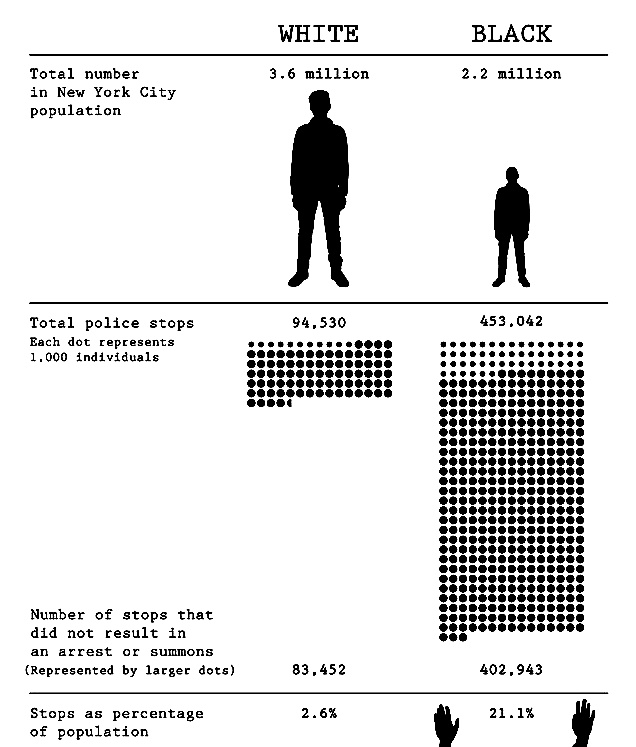
Graph from the New York Civil LIberties Union
For Women in Street Stops, Deeper Humiliation, By Wendy Ruderman, New York Times, August 7, 2012 http://www.nytimes.com/2012/08/07/nyregion/for-women-in-street-stops-deeper-humiliation.html?hp “What’s this?” the officer said, examining the pill packaging stamped “drospirenone/ethinylestradiol.” “Birth control,” Ms. Archibald remembered saying. She took a breath and exhaled deeply, hoping the whoosh of air would cool her temper and contain her humiliation as the officers proceeded to pat her down. The laws governing street stops are blind to gender. Male officers are permitted to frisk a woman if they reasonably suspect that she may be armed with a dangerous weapon that could be used to harm them. A frisk can escalate into a field search if officers feel a suspicious bulge while patting down the woman’s outer layer of clothing or the outline of her purse. Last year, New York City police officers stopped 46,784 women, frisking nearly 16,000. Guns were found in 59 cases, according to an analysis of police statistics by The New York Times. While the number of women stopped by officers in 2011 represented 6.9 percent of all police stops, the rate of guns found on both men and women was equally low, 0.12 percent and 0.13 percent, respectively. Civil rights leaders have argued that the low gun-recovery rates are a strong indication that the bulk of stop-and-frisk encounters are legally unjustified. (The number of police stops has dropped by more than 34 percent in recent months.) When officers conduct stops upon shaky or baseless legal foundations, people of both sexes often say they felt violated. Yet stops of women by male officers can often involve an additional element of embarrassment and perhaps sexual intimidation, according to women who provided their accounts of being stopped by the police. And many incorrectly believe that the police, like Transportation Security Administration officers, are required to have female officers frisk women. __________
“Drop in Stop-and-Frisks Not a Sign of Policy Change: Bloomberg” By Colby Hamilton, WNYC, August 06, 2012” Mayor Michael Bloomberg denied any suggestion that the recent drop in the number of stop-and-frisks conducted by police signaled an overall change in policy. __________
“Stop-and-Frisks, Crime Spikes and a Lesson in Statistics” By John Surico, Village Voice, August 4, 2012” http://blogs.villagevoice.com/runninscared/2012/08/the_stop-and-fr.php This morning, the New York Post had a breakthrough: its reporters came to the conclusion that the widespread practice of stop-and-frisk by the NYPD is a success. We solved it, guys. No more complaining about the infringement on constitutional rights, racial profiling or any of that other left-leaning drivel that the NYCLU loves to cook up. But how did the Post come to this conclusion? Well, the media organization simply just looked at the numbers. According to Rebecca Harshbarger and David Seifman, the reason why we can lay out the 'Mission Accomplished' banner for the controversial means of searching citizens, notably minorities, is because of the corresponding crime statistics that go with it. Exhibit A: Between January 1st and March 31st, there were 203,500 individuals who were stop and frisked, 881 guns seized and 24,571 crimes recorded in the books. Exhibit B: Between April 1st and June 30th, there were 133,934 stop-and-frisk targets with 732 guns seized and 27,832 major crimes reported. Notice the drop in stop-and-frisks and the 12% spike in crime. Well, there you have it, people - it's a wrap... unless you've ever taken a class in statistics. Then, this conclusion might seem a little far-fetched to believe. Okay, how do we say this to the Post and its conclusion without coming off as pretentious, finger-wagging elitists that have no sense of a reality that doesn't include being judgmental. This is going to be hard; take a deep breath, John. Well, here goes nothing: You can't do that. You just can't. Although this is hardly mentioned anywhere in the media besides maybe in Ezra Klein or Nate Silver's writing, what the New York Post did with the stop-and-frisk and crime numbers is against mathematical axioms. And the rule-breaking is simple: you cannot make a wholehearted declaration of something based on a correlation. It is statistical logic that just because X spiked and Y fell flat doesn't mean that X and Y are in bed together. A correlation is basically a relationship between two factors that may have some sort effect on each other; when you write research papers smothered in statistics, every student knows to stress that maybe. In other words, one doesn't necessarily explain the other. What the Post is doing underlies the main problem with basing a conclusion off of a correlation: there are other factors we must all take into account.... But sometimes numbers don't mean all they seem. Today's story by the New York Post — that says that the number of police stops fell 34 percent in the second quarter of 2012 — is certainly interesting. But quarter-to-quarter changes in the number of NYPD stops are not uncommon: In 2011, the number dropped 15 percent between the second and third quarters, then jumped 12 percent over the last three months of the year. Even bigger shifts occurred earlier under Mayor Bloomberg: From 2006 to 2007, the annual number of stops dropped by 33,000, before beginning a steady rise — at least until now. But questions of significance aside, the sharp drop in stops will become fodder for those who've claimed that crime is spiking in the city because political pressure in May and June forced the NYPD to back down on its street stops.... __________
“Your Camera Can Stop NYPD Abuse. See a stop-and-frisk? Record it on your phone.” By David Galarza, New York Daily News, August 3, 2012 http://www.nydailynews.com/opinion/camera-stop-nypd-abuse-article-1.1127761 __________
PHOTES OF THE NYPD MAKING FRISKS AND ILLEGAL SEARCHES by Jazz Hayden
Pat down on Broadway in Harlem / photo by Jazz Hayden
Reaching into a pocket / photo by Jazz Hayden
Reaching and searching in other pocket / photo by Jazz Hayden
Reaching into pocket of second man / photo by Jazz Hayden
_______________
“What's Stop and Frisk Got To Do With It?” By Jarrett Murphy, August 3, 2012 http://www.theinvestigativefund.org/blog/1676/what%27s_stop_and_frisk_got_to_do_with_it/ Many critics of the New York Police Department's mass stop-and-question or frisk policy focus not on the race of the people stopped but on the sheer volume of encounters. They say this reflects a larger problem for the NYPD: an obsession with metrics. The incredible decrease in crime during the 1990s attached enormous political weight to the city's statistics on major felony offenses. Inside the department, observers say, this translated into a fixation with numbers... Well, given the steep drop in stops, what is happening to crime? So far in 2012, murders and car thefts are down in the city compared to the same period last year. Rape (4.7 percent), robbery (5.9 percent) and grand larceny (9.8 percent) are up considerably, while felonious assault and burglary have climbed 2 percent or less. Is the decrease in stop-and-frisk an explanation for the increases? Maybe. Or maybe not. Crime was reported to be up early in the year, when the number of stops had actually increased. After the first quarter, New York was on pace to stop 800,000 people this year. It's important to remember that the second quarter decrease is coming off a record high in January-March. Beyond that, recent experience establishes little pattern for how stops and crime interact. According to the FBI, from 2010 to 2011 the number of violent crimes in New York City increased 6 percent. Was this because the NYPD had decreased its number of stops? Nope. The number of NYPD encounters soared 14 percent last year. On the other hand, from 2006 to 2007, as the number of NYPD stops dropped 7 percent, the number of violent crimes fell as well (by just over 3 percent). Obviously, this doesn't suggest NYPD stops cause crime. Sometimes stops rise in reaction to a crime jump. Sometimes they're not connected at all. In our analysis of stops in the 75th precinct last year, we found that the most common crimes associated with arrests made after stop-and-frisks were possession of marijuana and criminal trespass. Neither offense has much to do with the violence that's making headlines. _________
“Street Stops in New York Fall as Unease Over Tactic Grows” By Joseph Goldstein and Wendy Ruderman, August 3, 2012 The number of times police officers stopped, questioned and frisked people on the streets of New York City has dropped significantly, by more than 34 percent, in recent months, and a key contributing factor appears to be that police commanders have grown wary of pushing for such stops at daily roll calls, police supervisors said. At the same time, a general feeling of unease about the tactic by officers on the street — who have seen widespread criticism of so-called stop-and-frisks in the news media and by the courts — has also contributed to the drop, some say, with officers simply choosing not to question people they might have stopped before. The decline suggests that officers are unsure whether the political support remains for street stops, long a focal point of Police Commissioner Raymond W. Kelly’s crime-fighting strategy. In recent months, three court rulings have raised questions about the New York Police Department’s use of the tactic, and Mayor Michael R. Bloomberg and Mr. Kelly have put in place new measures aimed at ensuring lawful stops. “Cops are nervous, and supervisors are nervous” about the stop-and-frisk practice, said a police supervisor, explaining the drop. The supervisor, like other officers interviewed, spoke on the condition that he not be named for fear of angering his bosses. Another said that officers who were not pursuing as many stops were thinking to themselves, “I don’t want to be on the receiving end of any kind of allegation.” The Police Department conducted 203,500 stops in January, February and March this year, according to the department’s chief spokesman, Paul J. Browne — a record number. But in the second quarter — April, May and June — the police stopped 133,934 people, he said. During this period, the issue received considerable attention in the news media. The second-quarter stops were about 25 percent lower compared with the number of street stops in the second quarter of 2011, police officials said. Generally, about half of the street stops resulted in the police’s frisking the person, police officials said... New York’s police officials said that the department was not stepping away from the tactic and that the lower numbers merely reflected changes in the way armies of rookies were assigned to high-crime areas. Fewer officers have been assigned over the past few months to Operation Impact, a program that puts recent graduates of the Police Academy in high-crime neighborhoods with instructions to seek out suspicious behavior. These new officers conduct 30 percent to 40 percent of the department’s street stops, Mr. Kelly said.... Mr. Kelly acknowledged that the practice had come under scrutiny but said he did not believe that recent criticism by civil rights leaders played a role in the drop-off. He pointed to enhanced training and the “draw down” of Operation Impact officers.... There are three daily roll calls in each precinct, in which information is shared and crime patterns and assignments are discussed before officers go on patrol. In recent months, several officers said, many sergeants conducting roll calls have stopped emphasizing the need to stop and question people on the street. “They don’t ask for it anymore,” an officer in the Bronx said. “They just stopped.” This is key, the officer said, because when sergeants were asking for them, “it starts becoming a quota or a production goal.” “Why is it so important how many 250s someone did?” the officer added, referring to a form, a UF-250, filled out after a stop-and-frisk episode. A police officer in the Bronx said that officers detected a mixed message from the top. In recent months, the officer noted, Mr. Bloomberg’s support of the stop-and-frisk tactic has, in the eyes of many officers, softened. In addition, the officer noted, Mr. Kelly ordered all officers to go through retraining on how to conduct lawful stop-and-frisk encounters. “You see an about-face, and it’s like they’re saying there was something wrong with how it was done before,” the officer said. “Before, you had the mayor and the police commissioner defending stop and frisk to the end.” The officer also noted that a federal-court decision in May granted class-action status to a lawsuit on behalf of many New Yorkers who had been stopped. That decision, the officer said, had concerned officers, leading them to wonder if the federal judge was ultimately going to hold that the Police Department’s street stops had led to widespread Fourth Amendment violations. “People read those articles and realized this may be illegal,” the officer said. A Supreme Court decision in 1968 permitted the police to conduct street stops if they had a reasonable suspicion that criminal activity was afoot and to subsequently frisk the person if the officer was concerned for his or her safety because of a belief that the person was armed.... “I do believe there is a realization on the part of the New York Police Department that perhaps the number of stops got too large for the communities and the police officers to deal with,” the chairman of the City Council’s Public Safety Committee, Peter F. Vallone Jr. said. Mr. Vallone, who is generally supportive of the police’s use of street stops, said that the number of stop-and-frisk encounters had gone “higher than we should go,” given a reduced police force. He added that “officers had been left feeling the strain of a large amount of stop and frisks.” __________ “Stop-and-Frisk Episodes Drop: After setting a record in the first quarter of 2012, the New York police cut back on the number of warrantless stops they made from April 1 to June 30” New York Times, August 3, 2012 http://www.nytimes.com/interactive/2012/08/04/nyregion/0804-met-STOPS.html
__________ “Stop and Frisk Reduction Due to Better Trained Cops, Kelly Says” By Leslie Albrecht, Ben Fractenberg. DNAinfo, August 3, 2012 Well-trained cops ... are part of the reason stop-and-frisks have dropped dramatically this year, Police Commissioner Raymond Kelly said Friday. At a press conference at police headquarters, Kelly responded to a report that the controversial practice of cops stopping and searching people — the majority of whom are young black and Latino men — fell by 34 percent between the first and second quarters of this year. Viewed as a crime reduction tool by law enforcement, stop-and-frisk however has triggered criticism from elected officials and civil liberties groups.
Kelly linked the decline in part to a
department-wide retraining program where lawyers worked with officers to
explain exactly what type of behavior rises to the level of "reasonable
suspicion" and justifies a stop. The plummeting number of stop-and-frisks could also be related to how officers are deployed, Kelly said. The NYPD has reduced the number of "impact" officers — rookies assigned to high-crime areas — who conducted about 30 percent of stop and frisks earlier this year. __________
“NY Post Frequently Exploits Shooting Victims To Push Pro-'Stop-And-Frisk' Agenda, Media Matters” August 1, 2012 http://mediamatters.org/blog/2012/08/01/ny-post-frequently-exploits-shooting-victims-to/189058 With facts and statistics staring down the New York Post's attempted defenses of the New York Police Department's controversial stop-and-frisk agenda, the Post has been forced to resort to purely emotional appeals in their attempt to maintain public support for the policy. Over the past few months, the New York Post has published several news pieces dedicated to interrogating the friends and family members of recent New York City shooting victims. Each story features someone emotionally close to the case speculating about whether ramping up the New York Police Department's controversial "stop-and-frisk" policy could have saved their loved ones' lives. Meanwhile, the Post's editorial page has been littered with hyperbole and graphic imagery -- fear mongering designed to scare readers into believing that ending stop-and-frisk will result in "more blood in the streets." Several recent interviews in the news section of the New York Post have followed the above theme. Given the unconditional support for stop-and-frisk expressed by the Post's editors over past months, it's difficult to view these stories as anything more than an effort to exploit the raw emotions of their subjects in order to push the paper's political objectives in a "straight news" format.... __________
“Dinkins: Stop-And-Frisk Sometimes ‘Improperly Used’” By NY1 News, August 1, 2012 Former Mayor David Dinkins weighed in with NY1 on the growing controversy over the NYPD's stop-and-frisk policy on Wednesday. Speaking with political anchor Errol Louis on "Inside City Hall" Wednesday, Dinkins said stop-and-frisk may be a needed strategy but that it is often abused. __________
“In Harlem, a Surprising Pair, Allied Against Violence” By Wendy Ruderman, New York Times, July 31, 2012 It was an unusual pairing: the gruff and pragmatic police veteran who exhibits little tolerance for political rhetoric, and the Harlem political activist whose inflammatory oration once incited widespread criticism. Yet there they stood, Police Commissioner Raymond W. Kelly and Lenora B. Fulani, next to each other on Tuesday in a news conference at the Adam Clayton Powell Jr. State Office Building in Harlem. __________
“To Help Close the Achievement Gap, Address Stop-and-Frisk” By Udi Ofer, New York Times, July 26, 2012. Eighteen-year-old Angel Ortiz feels lucky when a stop-and-frisk encounter doesn’t also lead to a wrongful arrest. In February last year, when Angel was in the 10th grade, he was decidedly unlucky. After he left a friend’s home in Far Rockaway, Queens, two police officers stopped, handcuffed and arrested him for trespassing in the friend’s building, even though Angel had done nothing wrong. Angel spent several hours in jail and missed school to appear in Queens Criminal Court. All charges against him were eventually dropped, but his anger over how the police treated him lingers. Unfortunately, Angel’s experience is not unique. These sorts of encounters with the police have become rites of passage for many black and Latino young men who attend New York City public schools. First you learn to read and write, you study math and science, and if you’re lucky, you get to go to gym class. But soon after, you also learn how to put your hands up against the wall to be frisked, walk through metal detectors to go to school, and to remain calm when police officers rifle through your backpack without your permission... Anyone interested in increasing student achievement, and particularly in closing the achievement gap, should pay close attention to the impact of stop-and-frisk practices on the lives of black and Latino students, including on their view of authority and ability to succeed academically. According to an analysis conducted by the New York Civil Liberties Union, 21 percent of all N.Y.P.D. street stops last year — 145,652 — were of young people ages 8 to 18. Black and Latino youth comprise 89 percent of these stops, while white young people made up only 7 percent of the stops. Sixty-one percent of all stops of young people resulted in a frisk, a humiliating experience where a police officer pats you down, often forcefully, in public — a step that a police officer can take only if he or she believes that the young person has a weapon that poses a threat to the officer’s safety. And the data make clear that the N.Y.P.D. gets it wrong the vast majority of the time: Only 1.4 percent of frisks of young people in 2011 recovered a weapon. Force was used by the police on young people in 22 percent of the stops. Force can range from the pointing of a gun to an officer placing his or her hands on the young person. Force was disproportionately used against black or Latino youth (23 percent) compared to their white peers (15 percent). Most shocking is that 90 percent of all stops of young people did not result in an arrest or a ticket — meaning that in 131,087 of the stops, the young person being stopped was innocent of any action that would constitute a crime or an infraction. This experience on the street is only compounded by the experience that many young people face in school. The N.Y.P.D. arrested or ticketed more than 15 students each day in public schools during the first three months of 2012. More than 96 percent of the arrests were of black or Latino students. About 18 percent of the arrests were of students between the ages of 11 and 14. Disorderly conduct, a catchall category that could encompass all kinds of typical misbehavior, accounted for 71 percent of all summonses. While we have plenty of data on the number of young people subjected to N.Y.P.D. street stops, and on the number of young people stopped and frisked who engaged in no wrongdoing, the data do not capture how being wrongfully stopped and frisked affects the lives of young people... The Police Department’s stop-and-frisk program requires thousands of innocent young people of color to suffer repeatedly the indignities associated with routine police stops and searches on public sidewalks. These stops breed distrust, disaffection and anger, and these feelings subsequently must enter into the classroom, affecting not only the individual student but the entire school community.... The City Council has also introduced legislation to rein in stop-and-frisk abuses, including by protecting New Yorkers against racial profiling by the N.Y.P.D. and creating an N.Y.P.D. Inspector General’s Office. These reforms will not only lead to better policing, but will also help close the achievement gap. __________
Graph from DNAinfo NY __________
“Stop and Frisk: The Stories Behind the Numbers” By Vince Warren, Huffington Post, July 25, 2012 http://www.huffingtonpost.com/vincent-warren/stop-and-frisk-the-storie_b_1703449.html Unless you've been living under a rock, you know that the New York City Police Department (NYPD) stops and frisks well over a half a million New Yorkers every year. You know that that are glaring racial disparities in who gets stopped. You know that the courts are increasingly critical of the practice, with one judge decrying the city's "deeply troubling apathy towards New Yorkers' most fundamental constitutional rights." The issue has been litigated in two successive court cases since 1999, last month 10,000 people marched down Fifth Avenue in silent protest, and even the New York City Council is taking aim at curbing stop-and-frisk abuses through proposed legislation. But unless you've been stopped yourself, or you live in city neighborhoods where hundreds of people get stopped each day, you don't know what it's like to live under these conditions. You don't know what it's like to walk around feeling constantly targeted; when "you're a person of color; you already 'fit the description,'" as one man put it. You may not understand the corrosive effect of living in neighborhoods that are described as "an occupied zone" where residents feel "like you're in an outside prison," as another described it. It's hard to comprehend what it's like to grow up and be stopped regularly on your way to school or told by the cops you can't play outside the building you live in. Or what it's like to walk by a school and "see all these little kids lined up, with their legs spread, holding [onto] the wall, and the cops are going through their pockets." These stories and dozens of others have been collected and are being released today in a first-of-its-kind report that looks at the stories behind the stop-and-frisk numbers. "Stop and Frisk: The Human Impact" was researched and written by the Center for Constitutional Rights, the organization that has led the legal fight to end unlawful stops, first in the Daniels v. City of New York case that brought an end to the NYPD's infamous Street Crimes Unit and now in Floyd v. City of New York, which is challenging the stop-and-frisk policy as racially discriminatory and unconstitutional. The report is an intimate look into the experience and devastating consequences of a practice that has upended the lives of hundreds of thousands of New Yorkers. We wrote it because behind every cold statistic logged in NYPD records there is a human being, and the true toll this practice takes on our city cannot be understood without hearing these stories. A police stop in New York City is not a minor inconvenience. It is a frightening and humiliating experience, one that more often than not leaves people mistrustful of the police and changes their daily routines. Some are physically abused or sexually harassed, but even stops that are not abusive in these ways are inherently abusive of the spirit: "When they stop you on the street, and then everybody's looking...it does degrade you," one woman explained. People live in fear; they make sure to take ID with them, even if they're just going out to walk the dog. They think twice about inviting friends over, because their friends always get stopped on the way. "When the police come around, I make sure to keep my head down," one 24-year old told us. "I'm very cautious of where I go....at this point in my life, I take transportation, literal transportation, like bus and train. I don't really walk anymore." Entire communities are targeted and feel targeted - Black and Latino men above all, but also LGBTQ people, homeless and low-income people, immigrants, religious minorities and youth. Residents in some neighborhoods feel like they are living under siege. "There's this constant fear that...police are going to intimidate and harass you," one of the people CCR interviewed said. "Sitting on your porch or going to the store or like having fun in your community -you don't really get to do that because you have police presence in the street all the time." Perhaps the most depressing quote we got during our research was this: "It's so frequent, we don't even talk about it or complain about it. It's to be expected." This is what life has become for people in the supposedly greatest city in the leading democracy of the world. It is more than just our citizens and our neighborhoods that are under siege - our Constitution is under siege, our humanity is under siege. There is a growing movement that is fighting back, through litigation, through legislation, through protest. "Stop and Frisk: The Human Impact" reminds us all of what's at stake in this fight. You can download a copy of the report here.
Stop and Frisk: The Human Impact: The Stories Behind The Numbers, The Effects On Our Communities, Center for Constitutional Rights Report, July 2010 http://ccrjustice.org/the-human-impact-report.pdf __________ “An NYPD Officer Analyzes the Controversial Stop and Frisk Debate” By Eugene Durante, Highbrow Magazine, July 24, 2012 http://highbrowmagazine.com/1402-nypd-officer-analyzes-controversial-stop-and-frisk-debate The summer of 2012 has not been kind to U.S. law enforcement officials. As Occupy Wall Street protests subsided, the momentum shifted away from America’s financial sector and toward the long simmering issue of police-community relations. Spurred on by the Trayvon Martin shooting, many citizens around the nation redirected their protests and rallied against ‘illegal and unwarranted’ stops by the police. The Federal Court in New York City added more public pressure by granting approval of a class-action suit brought against the NYPD for “suspicionless stops and frisks.” The court’s approval of the suit was bolstered by an American Civil Liberties Union study related to stop-and-frisk data collected by the NYPD. The culmination of these incidents has kept the stop-and-frisk on the public’s mind. While protests increase nationwide, academics and media commentators from across the nation have joined the debate.... [Long essay by current NYPD officer] __________
from DNAinfo NY
“Stop-And-Frisk: Out Of 1,324 Local Searches At Sheepshead-Nostrand Houses, Zero Guns Are Found” By Laura Vladimirova, Sheephead Bites, July 24, 2012 http://www.sheepsheadbites.com/2012/07/stop-and-frisk-sheepshead-nostrand-houses/ WNYC took it upon themselves to map all of the street stops – a.k.a. stop and frisks – using information from the police department showcasing where guns were recovered last year, since firearm control has been the primary justification for the controversial tactic. The map reveals that, in Sheepshead Bay, the NYPD has turned up no firearms in the areas in which NYPD has concentrated its use of stop-and-frisk tactics. In Sheepshead Bay, police made 1,324 stops in the Sheepshead Bay-Nostrand Housing projects. Yet only two guns were found in the 61st Precinct’s command, and neither were in the vicinity of the projects.... An NYCLU analysis revealed that New Yorkers (mostly black or Latino) have been subjected to police stops and street interrogations more than 4 million times since 2002, and that nearly nine out of 10 stopped-and-frisked New Yorkers were innocent. Commissioner Raymond Kelly and Mayor Michael Bloomberg say that stop-and-frisk is meant to get illegal guns out of the streets and criminals behind bars. “You hear all the time from people who don’t like stop-and-frisk. But you know what people really hate in New York City, and always have? Guns,” said Kelly. Current data shows that out of 685,000 stops in 2011, about 770 guns were recovered. This means that only one tenth of one percent of all stops resulted in cops finding a gun.
__________
“Map: NYPD Finds Most Guns Outside Stop-and-Frisk Hotspots” By Ailsa Chang, July 16, 2012 Mayor Michael Bloomberg and Police Commissioner Raymond Kelly argue the main purpose of stop-and-frisk is to get guns off the street. Out of more than 685,000 stops in 2011, about 770 guns were recovered. That means about one tenth of one percent of all stops result in the seizure of a gun. But those guns are not showing up in the places where the police are devoting the most stop-and-frisk resources. Using data from the New York City police department, WNYC mapped all street stops by police that resulted in the recovery of a gun last year. The digital map shows an interesting pattern. We located all the "hot spots" where stop and frisks are concentrated in the city, and found that most guns were recovered on people outside those hot spots meaning police aren't finding guns where they're looking the hardest. __________
“What the Courts Say About Stop-and-Frisk” By Ira Glasser, New York Times Letter, July 11, 2012 http://www.nytimes.com/2012/07/17/opinion/what-the-courts-say-about-stop-and-frisk.html Courts Putting Stop-and-Frisk Policy on Trial (front page, July 11) attributes the claim of unconstitutionality to ìrecent rulings by federal and state courts.î But even aside from the racial targeting of these frisks, the law has been clear for more than 40 years, and New York City has been blatantly violating it. Ever since a Supreme Court ruling in 1968, reiterated a number of times over 25 years, the law regarding when police officers are allowed to frisk has been clear: police may legally frisk people only if they have a reasonable suspicion, based on articulable facts, not a hunch, that the person frisked is armed and dangerous. That the police rarely have legally adequate reason to frisk is proved by the fact that their own statistics show that they find guns as a result of such frisks in less than two-tenths of 1 percent of the frisks ó more than 380,000 of them last year, more than 85 percent of them blacks and Latinos. Either the police are spectacularly incompetent at assessing reasonable suspicion, or they are frisking illegally. Mayor Michael R. Bloomberg has tried to rally public support for this unconstitutional policy by claiming that it prevents crime, but he provides no proof of this claim. How is crime prevented by violating the rights of innocent people? The writer is a former executive director of the American Civil Liberties Union. __________
“2,000 Stop-And-Frisk Videos Sent, NYPD Remains Against App” By Jaípheth Toulson, Amsterdam News, July 5, 2012 More than 2,000 people have already sent in stop-and-frisk videos using the New York Civil Liberties Union’s (NYCLU) lauded smartphone application “Stop and Frisk Watch.” The free smartphone application was introduced nearly three weeks ago and has already been making steady progress, although many of the videos sent in are of people testing out the app, which has a “Shake to Send” feature built in. Regardless, NYCLU Director of Communications Jennifer Carnig said the NYLCU will be investigating the videos to look for signs of police aggression during stop-and-frisks. __________
TOP 25 STOP & FRISK SPOTS IN NEW YORK CITY
From DNAinfo NY ________________ "Under siege: 'Stop and frisk' polarizes New York" By Chris Francescani, Janet Roberts and Melanie Hicken, Reuters, July 3, 2012 (3,000 word article) http://www.reuters.com/assets/print?aid=USBRE86205Q20120703 Telly Hudgins has been stopped and frisked by the police too many times to count in the Brownsville, New York, public housing project where he lives. One occasion sticks in his memory. "I had my pajamas on and my slippers on and I'm emptying my garbage" at the trash chute. "They asked me for ID to prove I lived there. Who walks around in their pajamas with ID?" asked the black, 35-year-old counselor for the mentally handicapped. He says he complained about the search and was issued a summons for disorderly conduct.... For nearly two months the NYPD's stop-and-frisk policy has drawn New York City into an emotional debate about race, policing and Fourth Amendment rights. Mayor Michael Bloomberg and Police Commissioner Ray Kelly have fiercely defended the program against an onslaught of criticism from judges, civil rights leaders and a vocal block of Democratic politicians. It has become a defining issue for next year's mayoral election. For Bloomberg, an independent who will be stepping down next year after three terms, the question is central to his legacy. Having presided over an historic reduction in violent crime, he boasts that New York is "America's safest city by far," a place where tourists and residents can safely roam any neighborhood, even those traditionally considered dangerous, by day and most by night. WHAT PRICE SAFETY? Critics, though, charge that this has come at a precious cost - the civil liberties of hundreds of thousands who are stopped and searched each year. Police stops in New York City have climbed steadily to more than 685,000 last year from nearly 161,000 in 2003. Only 12 percent of those stopped were arrested or ticketed. More than 85 percent were black or Hispanic, while they make up 51 percent of the city's population. A Reuters analysis of more than 3 million stops from 2006 through 2011 shows that by far the densest concentrations fell in areas of public housing, home to many of the city's poorest families and where 90 percent of residents are black or Hispanic. Although one would expect a heavy concentration of police stops in these densely populated areas, the stop rate is disproportionate: In 2011, police stopped people in these areas at a rate more than three times higher than elsewhere in the city, the analysis found. (much more here __________
"'Stop and Frisk' Continues to Target New York's Poorest People by Dashiell Bennett, The Atlantic, July 3, 2012" Amid recent noise about New York City's controversial "stop and frisk" policy, Reuters had done a deep dive into five years of worth of police data to see where (and to whom) the vast majority of searches take place. Unsurprisingly, police concentrate their efforts in the neighborhoods with the highest crime rates — which also happen to be the neighborhoods with the poorest and largely minority residents. Yet, even accounting for the excess violence in those areas, streets stops far outweigh the average for other neighborhoods. For example, Precinct 73 in Brownsville, Brooklyn, saw the second highest rate of violent crime in the city last year, with 14.1 violent crimes per 1,000 residents. The more affluent Park Slope has one of the lowest, at 4.1 crimes per 1,000 residents. That's a rate about three times lower than the rate in Brownsville. Yet, the rate of stops in Brownsville was 572 per 1,000 residents, which is 16 times higher than the rate in Park Slope. The stops also tend to be heavily concentrated in public housing projects, even inside the buildings themselves, where police patrols include walking the floors and stairwells. Many residents (who are much poorer than the average New Yorker and overwhelmingly black and Latino) approve of the added police presence, but others complain about being harassed by cops simply for taking out the garbage. Having police so closely monitoring your home creates a dangerous level of animosity between cops and the people they are there to protect. Since some of the Brownsville are kids and old people who almost never get stopped, that aggressively high rate means most young, black men in the area are stopped several times a year. And arrests often meaning handcuffing and hauling away people in front of their families.
__________ "Stop and Frisk" Letter to the Editor, New York Times, June 27, 2012 Re “Rude or Polite, City’s Officers Leave Raw Feelings in Stops” (front page, June 27): The term “stop and frisk” rolls off the tongue with such ease that we often forget the fact that a stop does not justify a frisk. To stop a person lawfully, a police officer must have reasonable suspicion that the person has committed, is committing or is about to commit an unlawful act. Then, even if a stop is appropriate, officers can conduct a frisk only in the rare circumstance when they reasonably suspect that a person has a weapon that might endanger officer safety. Despite this limitation, nearly 56 percent of those stopped by the New York Police Department in 2011 were frisked. Those frisks produced a weapon less than 2 percent of the time. These statistics clearly show that the N.Y.P.D. routinely frisks people without legal justification. How else to explain the huge number of innocent and unarmed people frisked? Used lawfully, street stops are an acceptable law enforcement tool. But the N.Y.P.D.’s rampant abuse of the tactic, courteous or not, is an unconstitutional violation of civil rights that sows mistrust between the police and the public they serve.
DONNA LIEBERMAN ___________
Photo: Michael Appleton for The New York Times Thousands of people marched down Fifth Avenue from 110th Street on Father's Day, June 17, 2012, to protest the New York Police Department's stop-and-frisk policies. ___________ Most of the time, the officers swoop in, hornetlike, with a command to stop: “Yo! You, come here. Get against the wall.” They batter away with questions, sometimes laced with profanity, racial slurs and insults: “Where’s the weed?” “Where’s the guns?” The officers tell those who ask why they have been stopped to shut up, using names like immigrant, old man or “bro.” Next comes the frisk, the rummaging through pockets and backpacks. Then they are gone. Other times, the officers are polite, their introductions almost gentle. “Hey, how’s it going?” “Can you step over here, sir?” “We’d like to talk to you.” The questions are probing, authoritative, but less accusatory. “What are you doing here?” “Do you live here?” “Can I see some identification, please?” During the pat-down, they ask, “Do you have anything on you?” They nudge further: “You don’t mind if I search you, do you?” They explain that someone of a matching description robbed a store a few days ago, or that the stop is a random one, part of a program in a high-crime area. Then they apologize for the stop and say the person is free to go. In interviews with 100 people who said they had been stopped by the New York police in neighborhoods where the practice is most common, many said the experience left them feeling intruded upon and humiliated. And even when officers extended niceties, like “Have a nice night,” or called them “sir” and “ma’am,” people said they questioned whether the officer was being genuine. Michael Delgado, 18, said he was last stopped on Grant Street in East New York, Brooklyn. “I was walking, and a cop said, ‘Where’s the weed?’ ” he recalled. “In my mind, I’m like, ‘Yo, this guy’s a racist.’ He started frisking me, his hands were in my pockets, but I didn’t say anything because my mom always tells me: ‘No altercations. Let him do his thing.’ ” When the stop-and-frisk was done, Mr. Delgado said, the officer left him with a casual aside to stay safe. “Stay safe?” Mr. Delgado said. “After he just did all that?” Last year, city police officers stopped nearly 686,000 people, 84 percent of them black or Latino. The vast majority — 88 percent of the stops — led to neither an arrest nor a summons, although officers said they had enough reasonable suspicion to conduct a frisk in roughly half of the total stops, according to statistics provided by the New York Police Department and the Center for Constitutional Rights. Behind each number is a singular and salient interaction between the officers and the person they have stopped. In conducting the interviews, The New York Times sought to explore the simple architecture of the stops — the officers’ words and gestures, actions, explanations, tones of voice and demeanors. What seems clear is that there is no script for the encounters, or that if there is one, it is not being followed. Under the law, officers must have a reasonable suspicion — a belief that a crime is afoot — to stop, question and frisk people. One thing an officer cannot do is stop someone based solely on skin color. Yet many of those interviewed said they believed that officers had stopped them because of race — and race alone. Al Blount, a minister at a Harlem church, said he had been pulled over. “They’ll ask, ‘Where are you headed?’ When you’re African-American, you have to have a definite destination. Everyone else can just say, ‘Mind your own business.’ ” Last month, a federal judge granted class-action status to a lawsuit alleging that the Police Department’s stop-and-frisk tactics systematically violated the constitutional rights of blacks and Latinos, who say they are singled out for stops.... The informal street survey, conducted over the past two weeks, sought to get at the root of an angry groundswell against the police among residents in predominantly minority and poor neighborhoods. The interviews consisted of five questions: When and where were you stopped? What was the first thing the police officer said to you? How did the officer address you? Did the officer ever explain why he or she had stopped you? What was the last thing the officer said to you? The answers offered a glimpse into the experience and why it often leaves such a bitter taste in the mouths of so many who have been stopped, and raised questions about whether the Police Department’s new emphasis on courtesy and respect would help mend relationships in predominantly minority neighborhoods. While the encounter is often brief, the impression can be long-lasting. “I understand that they might need to be aggressive with some people, but you just feel it,” said Christopher A. Chadwick, 20, a college student from Brooklyn. “They talk to you like you’re ignorant, like you’re an animal.” Mr. Chadwick described a stop that began when an officer said: “You, come here. Show me your ID.” Cruz Calixto, 48, said the foot-patrol officers who approached him last summer as he walked down Rockaway Boulevard in Queens were mild-mannered. “ ‘Can you step over here sir? We’d like to talk to you,’ ” Mr. Calixto recounted. Still, the encounter was degrading. “It makes you feel belittled,” he said.... The department recently distributed thousands of wallet-size cards — labeled “What Is A Stop, Question and Frisk Encounter?” — to precincts across the city. Officers have been encouraged to give the cards to people they have stopped; at the bottom of the card is essentially a one-sentence, conditional apology: “If you have been stopped and were not involved in any criminal activity, the N.Y.P.D. regrets any inconvenience.” Of the people interviewed, only one, Derrick Smith, said that officers had provided the card — in an exchange witnessed by The Times. Mr. Smith, 47, had been stopped as he emerged from the subway in East New York. He said the officers told him they had seen a suspicious bulge in his shirt. “I had to lift my shirt; I was coming home from work,” Mr. Smith said. “It was just my cellphone.” As Mr. Smith spoke with reporters, the officers returned to hand him one of the cards. Many of those interviewed said that they resented being stopped, but that the officers’ demeanor made the experience far worse. On an evening about a month ago, while walking with friends on Northern Boulevard near 78th Street, in Queens, Louis Morales, 15, and Alex Mejia, 16, found themselves swarmed by plainclothes narcotics officers. They shoved the teenagers’ palms onto an unmarked police car and searched them. Spewing expletives, the officers repeatedly ordered them to “shut up,” the teenagers said. One of the officers, Mr. Morales said, warned: “Say one word and I’m going to make your parents pick you up at the jail. You guys are a bunch of immigrants.” “Yep, that’s what they said, ‘You guys are immigrants,’ ” Mr. Mejia interjected. “We can’t say anything to them. They curse at us. They treat us like we killed somebody.” Mr. Morales said he and other neighborhood teenagers had become so bitter that even if they had information about a crime, they would not share it with the police. “I’m not going to help them,” he said. “They are not helping me by disrespecting me.” Most of those interviewed said they could not remember the exact date and time when they were stopped and only six or seven said they knew the name of the officers involved. The sentiment, however, was clearer. On a recent early evening in Brownsville, Brooklyn, Eric Togar said, he was on his way to meet his wife and her younger brother in front of the Langston Hughes Houses, where a cream-colored stretch limousine was on its way to take Mr. Togar’s teenage brother-in-law to a prom. The police cruiser pulled up, with lights activated, and two officers jumped out. The officers asked if he was wanted on a warrant, said Mr. Togar, 45, a computer technician. They asked to see identification and what was inside the red backpack slung over his shoulder. “Computers and tablets,” he told them. Mr. Togar said they patted him down, offering no explanation, then told him he could go. Mr. Togar almost missed the prom send-off. “They’re supposed to serve and protect, but all they do is patrol and control,” Mr. Togar said. “Walking down the street doesn’t make you a criminal.”
Photo: Robert Stolarik for The New
York Times ___________
Yesterday the NYPD loaded reporters onto a bus and drove them up to the Bronx to view their updated stop-and-frisk training program at the department's Rodman's Neck facility... The combination of cloying overtures from the famously brusque NYPD press officers with a training facility that resembled a movie set made the entire experience feel like a Hollywood B-movie, Field Trip: Stop & Frisk. The surreality ended at the press conference, which followed the live-action demonstrations of three stop-and-frisk scenarios that 1,300 "high-impact" officers (those most likely to conduct stops) have completed since April, and are now required for new recruits. Two of the scenarios involved radio calls, the other a domestic disturbance. Weren't more than half of the 601,055 stops conducted last year for "furtive movements?" Why not incorporate those? "I think that everything you saw was realistic," Dr. James O'Keefe, Deputy Commissioner of Training said.... Also detracting from the scenarios' realism: the only man actually detained was white, and the officers assigned to performing the stops were seasoned detectives, not officers feeling their way through the exercise. There would be no learning curve, no adjustment of techniques. These two were perfect. We asked if the new training incorporated Commissioner Kelly's order in September to stop arresting citizens (mostly young men of color) who are essentially tricked into bringing small amounts of marijuana into public view—turning violations into misdemeanors—during stop-and-frisks. "That's not currently part of the training," O'Keefe said. Deputy Commissioner for Public Information Paul Browne asked Inspector Kerry Sweet, the executive officer of the NYPD's Legal Bureau to chime in. "We enforce the law as it is," Sweet said, as another six people were arrested for marijuana possession. "If there are legislative changes, we will address the changes." ___________ “Video: How Do Real Stop & Frisks Compare To NYPD Training Simulations?” By Christopher Robbins. Gothamist, June 21, 2012 [posting of a number of videos by Jazz Hayden showing stop and frisks] http://gothamist.com/2012/06/21/video_how_do_real_stop_frisks_compa.php ___________
“How Stop-and-Frisk (Not So) Quietly Became the Center of NYC Politics, by Seth Freed Wessler, Colorlines, June 18, 2012 http://colorlines.com/archives/2012/06/fathers_day_march_against_stop-and-frisk.html Beneath the sounds of birds and children playing in Central Park, thousands marched quietly down Manhattan’s 5th avenue on Sunday afternoon carrying signs bearing the faces of a decade of victims of police violence and the words “Stop Racial Profiling: End Stop and Frisk.” Contingents from nearly 300 groups including labor unions, community groups, national civil rights organizations as well as the unaffiliated gathered in Harlem and marched past khaki-clad upper east siders walking their poodles, to the home of Mayor Michael Bloomberg. Their demand? An end to racial profiling and in particular to the cops’ use of stop-and-frisk, a practice marchers say has terrorized communities of color for more than a decade. “You can’t do something like this that many times to that many people for that long and not have this kind of march,” said Carlos, a 39-year-old African American man who joined the march after hearing Reverend Al Sharpton talk about it on his radio show. Carlos told Colorlines.com that in the 12 years since he moved from Florida to Harlem for a job as an electrical engineer, “I’ve been stopped more than 50 times while walking down the street. It’s gotten so ridiculously out of control to the point where Bloomberg’s guys are stopping everyone.” The Father’s Day march was the most public display of outrage against the stop-and-frisk policy to date. The cops conducted nearly 700,000 searches last year alone. March leaders included national civil rights figures including Sharpton and NAACP President Ben Jealous who marched with the family of Ramarley Graham, a young man recently killed by New York City cops. Marchers included the field of Democratic mayoral hopefuls and a diverse coalition from across New York. As the 2013 election inches closer and Democratic mayoral hopefuls scramble to differentiate themselves from the pack, years of police reform organizing has succeeded in pushing police accountability issues to the center of the race. It’s a movement that’s been long in the making and is now comprised of what some advocates say is an unprecedented coalition of city constituencies. The Data Doesn’t Lie The stop-and-frisk program has been the central issue in the fight for greater checks on the cops, largely because the numbers so starkly reveal a problem. New data has born out the reality on the street for hundreds of thousands of black and Latino men. Though the police tactic is now a decade and half old, started by Mayor Rudy Giuliani, the program that the police call “stop, question and frisk” exploded under the command of Mayor Bloomberg and his police commissioner Raymond Kelly. In 2002, Bloomberg’s first year as mayor, the NYPD conducted just under 100,000 of these searches on city streets and in subway stations and public housing complexes. In 2011, Bloomberg’s NYPD conducted 680,000 stops, 87 percent of whom were black and Latino men. In all, among black men and teens between 14 to 24, the total number of searches in 2011 was greater than their total population in the city. “Every person of color in the city knew these numbers before they came out,” said Djibril Toure, an organizer with the Malcolm X Grassroots Movement, which works in communities of color against police brutality. “But the numbers made it impossible for the rest the city not to see, too.” New York’s mayor and police commissioner say that the stop-and-frisk program is responsible for a rapid decline in crime in New York City. In a speech last week at a predominantly black church in Brooklyn, Bloomberg said “We are not going to walk away from a strategy that we know saves lives.” But there’s no evidence that the tactic is responsible for falling crime in the city. Meanwhile, the corrosive fallout in communities of color is palpable. “It’s gotten to the point where nobody can trust the cops anymore,” said Carlos, the marcher who would not share his last name. “It’s gotten to the point where I hate the cops, where I want to do something to them because they’ve done this to me so many times.” [Long article describes the history of attention to and activity around stop and frisks in NY City] __________
In a slow, somber procession, several thousand demonstrators conducted a silent march on Sunday down Fifth Avenue to protest the New York Police Department’s stop-and-frisk policies, which the organizers say single out minority groups and create an atmosphere of martial law for the city’s black and Latino residents.... The presence of several elected officials at the march, including the Democratic mayoral hopefuls Bill de Blasio, the public advocate; Christine C. Quinn, the City Council speaker; Scott M. Stringer, the Manhattan borough president; and William C. Thompson, the former city comptroller, seemed to signal a solidifying opposition to the policy, which has long been opposed by civil rights groups. Wade Cummings, 46, a teacher, attended with his 19-year-old son, Tarik. Both said they had been stopped by police officers — once for the father, three times for the son. “I’m concerned about him being stopped and it escalating,” the father said. “I like to believe I taught him not to escalate this situation, but you never know how it’s going to go down.” Police officers stopped nearly 700,000 people last year, 87 percent of them black or Latino. Of those stopped, more than half were also frisked.... Demonstrators mostly adhered to the organizers’ call to march in silence, hushing talkers along the route. Members of labor unions and the N.A.A.C.P. appeared to predominate, but there were also student groups, Occupy Wall Street, Common Cause, the Universal Zulu Nation and the Answer Coalition. A group of Quakers carried a banner criticizing the stop-and-frisk practice; other signs read, “Skin Color Is Not Reasonable Suspicion” and “Stop & Frisk: The New Jim Crow.” As of Friday, 299 organizations had endorsed the march, including unions, religious groups and Japanese, Chinese, Korean, Arab, and Jewish groups. The turnout reflected the growing alliance between civil rights groups and gay and lesbian activists, who in past years have often kept each other at arm’s length. Last month, the board of the N.A.A.C.P., which includes several church leaders, voted to endorse same-sex marriage. The roster of support for the march on Sunday included at least 28 gay, lesbian and transgender groups.... The idea for the demonstration took root three months ago in Selma, Ala., after a commemoration of the 1965 civil rights march there, said Benjamin Todd Jealous, the president of the N.A.A.C.P., who met there with the Rev. Al Sharpton and George Gresham, president of 1199 S.E.I.U. United Healthcare Workers East.... “Stop-and-frisk is a political tool, victimizing one group of people so another group feels protected,” Mr. Jealous said. “It’s humiliating hundreds of thousands of people.” According to a report by the New York Civil Liberties Union, during the 10 years of the Bloomberg administration, the police have performed 4,356,927 stops, including 685,724 last year. Among African-American males ages 14 to 24, the number of stops last year was greater than their total population. One man who held a sign that read “Stop Racial Profiling” said he came to Central Park to relax but decided to join the march because of his own experiences with the police. “It happened to me about 10 times,” said the man, Bruce Fitzgerald, 48, of the Bronx. Seeking a contrast to some recent Occupy Wall Street demonstrations, organizers called for a disciplined, orderly march, with no clashes with the police. Though protesters did not have a permit, organizers said that their talks with the police had been cordial and cooperative, and that they did not expect conflict. “This policy did not emanate from the rank-and-file police officers, and we’re not protesting them,” said Mr. Gresham, who was arrested at an Occupy protest in November. “We’re not going to the police commissioner’s home. We’re going to the mayor’s home, because he is the guardian of New York.” “If you’ve done nothing wrong, you deserve nothing but respect and courtesy from the police,” Mr. Bloomberg said. “Police Commissioner Kelly and I both believe we can do a better job in this area — and he’s instituted a number of reforms to do that.” At the end of the march, Mr. Jealous, who walked with his 6-year-old daughter, Morgan, on his shoulders, said the silence conveyed the seriousness of the demonstrators. “In this city of so much hustle and bustle and clamor, sometimes the loudest thing you can do is move together in silence,” he said.
________
“Stop-and-Frisks Have Done Little to Reduce Shootings” NYPD Data Show, By Murray Weiss, DNAinfo Columnist, Criminal Justice Editor, June 5, 2012 The skyrocketing numbers of NYPD stop-and-frisks had little impact on the number of people shot in New York City or on gun violence in general during Mayor Michael Bloomberg’s administration, a DNAinfo.com New York analysis of crime data has found. While the NYPD was stopping and frisking a record 685,724 people last year, 1,821 people were victims of gunfire, according to NYPD and city statistics. That's virtually the same number as in 2002, Bloomberg's first year in office, when 1,892 people were shot, but just 97,296 people were frisked. The year before, there were 1,845 shootings with a similar number of frisks. "If you have a flat-line situation with shootings, and the stops are this high, you are throwing everyone up against the wall and you are losing the community, then you have to reassess," a former top NYPD official told "On the Inside." "We are not a militia, but a police organization serving a community," the ex-cop continued. "We don’t want to be seen as an occupying army. We need the large majority of the community to be involved with us." Between 2009 and 2011, the number of people shot in New York climbed from 1,727 to 1,821 even as the NYPD was ratcheting up the number of people it rousted from 510,742 in 2009 to the record 685,724, the statistics showed. A similar pattern of rising shootings and escalating stop-and-frisks occurred from 2004 through 2006. During those years, the NYPD stop-and-frisks jumped 70 percent, from 313,523 to 506,491, but the number of shooting victims rose about 7 percent, from 1,777 to 1,880. During Bloomberg’s first five years in office, the number of stops and frisks went up five fold, from 97,296 in 2002 to 506,491 in 2006. But the numbers of shootings and victims — 1,556 and 1,880, respectively — remained about the same since he and Kelly started. Perhaps that helps explain why the NYPD kept the stop-and-frisk numbers a secret until February 2007 when they finally handed them over to the City Council, even though it was required following the 1999 fatal police shooting of Amadou Diallo. To be sure, part of the rise in stop-and-frisks is due to cops getting better at reporting the encounters. But this in no way explains away a seven-fold jump in 10 years.
"For City’s Teens, Stop And Frisk Is Black And White" By Ailsa Chang, by WNYC, May 29, 2012 One in five people stopped last year by the New York City police department was a teenager between the ages of 14 and 18, according to a WNYC analysis of recently released police data. Eighty-six percent of those teenagers who were stopped were either black or Latino, most of them boys. Last year, there were more than 120,000 stops of black and Latino kids between 14 and 18. The total number of black and Latino boys that age in the entire city isn’t much more than that – about 177,000 – which strongly suggests a teen male with dark skin in New York City will probably get stopped and frisked by the time he’s graduated from high school. The debate about stop and frisk’s racial disparities comes down to opponents who say it racially profiles and supporters who say the people stopped fit the descriptions of most suspects. The conversation, until now, has been dominated by lawyers, politicians, police officials and community leaders. But ask junior high and high school students around the city, from affluent to low-income neighborhoods, and most appear to agree on one main premise: who gets stopped and frisked has everything to do with where you live and what color your skin is. A Tale of Two Cities Last year, the NYPD stopped teenagers more than 140,000 times. But at Stuyvesant High School in Lower Manhattan, which is 96 percent Asian and white, you would be hard pressed to find even one kid among the 3,300 students who has ever been stopped and frisked. The students here, at one of the city’s most elite public high schools, are known to excel at academics. They are the eager students, the ones who raise their hands in class. But ask them how many of them have ever been stopped and frisked by police, and what you get back is a sea of blank stares.... Cross over to Brownsville, Brooklyn, where there aren’t many skinny white kids, and the story of stop and frisk suddenly becomes “A Tale of Two Cities.”
Photo: Malik Small, 14, (left) said he has been stopped four times by police. Tyari Jenkins, 14, (right) is an eighth grader at Teachers Preparatory High School in Browsville. Since getting stopped for the first time when he was 12, Tyari has wanted to become a criminal defense lawyer. Ailsa Chang/WNYC) The demographics of Teachers Preparatory High School in Brownsville are 99 percent black and Latino. It takes only five minutes to find a group of 14-year olds here who say they have been stopped by police two, three, even seven times.... In this area alone, kids between 14 and 18 made up more than 2,700 of the nearly 8,000 people stopped by police in 2011. Within a three-block radius around Stuyvesant High School in Manhattan, police stopped teens 7 times last year. Tyari Jenkins, a 14-year-old African-American student at Teachers Preparatory High School, said he has been stopped and frisked three times. The first time was as a 12-year-old, when he was barely five feet tall, he said. He had been walking out of his home to his friend’s house across the street. “When I looked up, I see the cop. He was like, ‘You,’ and I was like, ‘Me?’ He said, ‘Yeah,’” Tyari recalled. “He said, ‘Empty your book bag,’ and I was like, ‘Okay,’ and I was taking my time. Then he said, ‘You need to hurry up.’ And he started emptying my book bag and dropped my stuff on the ground.” The officers asked for an ID. Tyari said he left his at home, so the officers hauled him back home across the street and asked his mother to identify him. After a few minutes, they left. Tyari said he’s never been arrested for anything. Neither have any of the other Brownsville kids who shared their stories. They are now 14 years old, and all of them have been stopped by police between two and seven times. _____________
This month, a federal judge in New York dealt a blow to “stop-and-frisk,” a policy that resulted in 685,000 recorded police stops in 2011. Eighty-five percent of those stopped were African American and Latino, mostly youths. US district judge Shira Scheindlin granted class-action certification to a stop-and-frisk lawsuit against the city of New York... The plaintiffs allege that the NYPD's stop-and-frisk policy regularly violates the Constitution by illegally stopping and searching scores of people belonging to a particular demographic -- black and Latino.... The class-action ruling will put stop-and-frisk on trial. Plaintiffs in Floyd et al. vs City of New York also argue that they were stopped by police who did not have the legally necessary "reasonable suspicion" that they had committed or were going to commit a crime. What's more, the suit alleges, police often performed frisks, but not because they saw a bulge they suspected to be a weapon, another legal requirement. In her written decision, Scheindlin said the alleged constitutional violations result not from the actions of rogue officers, but from a policy handed down from the very top. "The stop-and-frisk program is centralized and hierarchical," said Scheindlin, "Those stops were made pursuant to a policy that is designed, implemented and monitored by the NYPD's administration." Scheindlin's ruling cites "overwhelming evidence" -- a spike in stop-and-frisks and the NYPD's own words -- indicating that at the "highest levels of the department," police are enforcing a policy that leaves behind a trail of daily injustices. For years, Mayor Bloomberg and Police Commissioner Kelly have used distortions and misinformation to promote and justify a policy that violates the constitutional rights of those who were stopped. Now, the Scheindlin findings have exposed the NYPD game for what it is, an illegal system of quotas and racial profiling imposed on field police from the top of the NYPD. "Suspicionless stops should never occur," Scheindlin wrote in her decision, adding that, "Defendants' cavalier attitude towards the prospect of a'"widespread practice of suspicionless stops' displays a deeply troubling apathy towards New Yorkers' most fundamental constitutional rights." Stop-and-frisk, which the data shows is a form of racial profiling, violates not only the Fourth Amendment -- protection from unreasonable searches -- but also the 14th Amendment, which includes the equal protection clause, the plaintiffs charge. The Scheindlin decision was informative and comprehensive, including a number of important facts and observations. Here are eight important points from the decision. 1. Soaring numbers. The rate of stops has grown exponentially under the Bloomberg administration... 2. No reasonable suspicion. Reasonable suspicion that a person is involved in a crime is necessary for a legal stop. Eighty-eight percent of those stopped, however, are not charged with any crime. As Scheindlin noted, the data shows that "according to their own records and judgment, officers' 'suspicion' was wrong nearly nine times out of ten." 3. Imaginary bulges.... A "suspicious bulge" was cited as a reason for about 10 percent of all [685,000] stops, but guns were seized in less than 1 percent. "For every 69 stops that police officers justified specifically on the basis of a suspicious bulge, they found one gun," the decision notes. 4. Stops for no reason. "Overall, in more than half a million documented stops -- 18.4 percent of the total -- officers listed no coherent suspected crime," Scheindlin wrote... 5. Unlawful stops. "According to their own explanations for their actions, NYPD officers conducted at least 170,000 unlawful stops between 2004 and 2009," Scheindlin wrote. Stops based on nothing more than "furtive movement" or a "high-crime area" were the justifications of at least 100,000 stops, but as Scheindlin says, [ such stops] are illegal due to the Fourth Amendment law protecting Americans from unreasonable searches. 6. Racial profiling. The NYPD's stop-and-frisk program targets blacks and Latinos because of their skin color. Scheindlin admitted the testimony of Columbia University professor Jeffrey Fagan, who found that police stopped blacks and Latinos far more than white residents. Isolated from other factors like crime rates and neighborhood racial composition, racial disparity from racial targeting was statistically significant, strongly underscoring that skin color is the essential factor in determining who gets stopped... Fagan's research also found that "the search for weapons is (a) unrelated to crime (b) takes place primarily where weapons offenses are less frequent than other crimes, and (c) is targeted at places where the black and Hispanic populations are highest." Cops are more likely to list no suspected crime category, or what Scheindlin called "an incoherent one," like "furtive movements," when stopping blacks and Latinos than when stopping whites. They are also more likely to use force against people of color. 7. NYPD illegal quotas. Scheindlin links the rising number of stops and the targeting of black and Latinos to NYPD quotas, and to Commissioner Kelly's own admission that the NYPD has a quota policy, albeit disguised.... Former NYPD officers turned whistleblowers Adil Polanco and Adrian Schoolcraft have collected evidence documenting NYPD quotas in practice. From 2008 to 2009, Polanco, from the 41st Precinct, and Schoolcraft, from the 81st, recorded roll calls revealing supervisors' and other high-ranking officers' enforcement of quotas. In Scheindlin's own words, Schoolcraft's audio files expose supervisors "repeatedly telling officers to conduct unlawful stops and arrests and explaining that the instructions for higher performance numbers are coming down the chain of command." Similarly, Polanco testified that "his commanding officers announced specific quotas for arrests and summons (quotas that rose dramatically between early 2008 and 2009) and for UF-250s" (a term for the forms used in stops), said Scheindlin, "and threatened overtime and undesirable assignments for those who failed to meet them."
STOP WATCH NYC MAP OF 670,000 RECORDED STOP AND FRISKS IN NEW YORK CITY IN 2011 click on the map to go to the intereactive version where you can put in an address.
______________ Alarmed by legal sanctions that allow police to stop and search individuals -- mostly persons of color -- in public places, the NAACP is holding a "Silent March Against Stop and Frisk" on Father's Day. The march, supported by the National Council of Churches and other faith, labor and civic groups, will begin at 1 p.m. June 17 at 110th Street between 5th Avenue and Lenox. "The arbitrary stopping and frisking of anyone -- especially persons of color -- is reminiscent of discredited police tactics of another era," said the Rev. Michael Livingston, director of the National Council of Churches Poverty Initiative and staff to the Council's Racial Justice Working Group.... Judith Roberts, director for Racial Justice Ministries, Congregational and Synodical Mission, of the Evangelical Lutheran Church in America, said the NCC Racial Justice Working Group is "focusing a great deal of attention on criminal justice in 2012." "We recognize that people of color in the United States are disproportionately impacted by unequal sentencing laws, racial profiling and institutional racism within our criminal justice system," Roberts said. "As people of faith, we are called to stand up against injustice." Organizers of the march said, "People of color should not be afraid to walk down the street in their own city. On June 17th, we will proudly walk with them to assert that right. Like thousands of activists before us, we will channel the power of our silence to bring public attention to the use of racial profiling by the New York Police Department." According to organizers, the tradition of silent marches for civil rights dates back to 1917, when the then 8-year-old NAACP held the first one in New York City to protest lynchings, segregation and race riots in the South. That march, led by NAACP founder W. E. B. DuBois, was the NAACP's first major public protest, and the power demonstrated by thousands of people marching silently through the streets of New York became an iconic symbol of strength in the face of injustice. "Silence is a powerful force that, like other forms of non-violent protest, holds a mirror to the brutality of one's opponents." say the organizers. "On June 17, we will hold up a mirror to New York City's stop-and-frisk policy. It is not only discriminatory, it actively seeks to humiliate innocent citizens—particularly African American and Latino men—and criminalize otherwise legal behavior.
The NAACP, Health Care Workers Union 1199, the
NYCLU, ______________
To listen to Mayor Michael R. Bloomberg and Commissioner Kelly — and their hallelujah chorus on the editorial boards of The Daily News and The New York Post — is to hear the same sad argument: Our victory over crime is so tenuous that only the mass stopping and frisking of black and Latino men keeps a sea-tide of violence at bay. Two weeks ago, Judge Shira A. Scheindlin of United States District Court declared this argument flatly unconstitutional. She found “overwhelming evidence” that top brass had put in place “a centralized stop-and-frisk program that has led to thousands of unlawful stops.” The department’s lawyers argued that stopping and frisking was a time-honored “social institution.” The judge batted down that argument, too. “Defendants’ cavalier attitude towards the prospect of a ‘widespread practice of suspicionless stops,’ ” she wrote, “displays a deeply troubling apathy towards New Yorkers’ most fundamental constitutional goals.” Stopping and frisking, done properly, is useful and legal. Officers can stop someone when they have reason to suspect that a crime has taken place or is about to take place. But that police favorite, “furtive movement”? No such legal animal exists. This is not just a fine point harped upon by federal judges. In the last few weeks I interviewed two officers in Bushwick who insisted that current policy required them to trespass across clear constitutional lines. “You can’t catch innocent young men in your nets and just say, ‘Oh, that’s all right, I’m fighting crime,’ ” a veteran officer said. “You have to follow the law.” Judge Scheindlin was withering on this question. She noted that many stops were illegal on their face and that even “according to their own records and judgment, officers’ ‘suspicion’ was wrong nearly 9 times out of 10.” Last week, two police officers told me several colleagues were in heavily attended remedial classes for those who fail to record enough stops and arrests. “They want five arrests a month for marijuana for some units,” he said. “If you can do that, you either have X-ray vision or you are breaking the law.” _____________
In 2001, then-former Police Commissioner Ray Kelly told Time magazine that when his successor claimed responsibility for falling crime rates, it was “like trying to take credit for an eclipse.” More than a decade later, this same Ray Kelly, now in his second stint as NYPD commissioner, defends his over-the-top stop-and-frisk program as responsible for a plummeting murder rate.... This is demonstrably false.... In fact, the city’s murder rate started dropping long before Kelly’s current tenure as commissioner, and there’s no evidence stop-and-frisk had anything to do with it.... By 2001, the year before Bloomberg hired Kelly, the number of murders had dropped to 649. That total fell to 587 in 2002, the year before the commissioner initiated his aggressive stop-and-frisk regime. From 2003 to 2011, a period that saw a 600% increase in street stops (from 97,296 to 685,724), there’s been an average of 544 murders per year. That amounts to about 430 fewer murders since the commissioner took office — a far cry from his claim of 5,600 saved lives. Sounds a little like taking credit for an eclipse.... At bottom, the NYPD’s stop-and-frisk regime represents a civil rights violation — one that disproportionally targets young black and Latino men. Though they make up only 4.7% of the city’s population, black and Latino males between the ages of 14 and 24 accounted for 41.6% of stops in 2011. The number of stops of young black men exceeded the city’s entire population of young black men. The commissioner contends that this happens only because officers go where the crime is. But last year, large percentages of blacks and Latinos were also stopped in overwhelmingly white neighborhoods like Greenwich Village, where 77% of people stopped were black or Latino. What’s more, “violent crime suspected” was a justification listed for only 10.5% of street stops in 2011. By far the most common reason listed was “furtive movement,” a catchall term that apparently applies to a wide assortment of innocent behavior. Discriminatory policing corrodes trust between police and communities, making everyone less safe. But don’t take my word for it. Again, listen to the old Ray Kelly, this time in 2000: “[A] large reservoir of good will was under construction when I left the Police Department in 1994. It was called community policing. But it was quickly abandoned for tough-sounding rhetoric and dubious stop-and-frisk tactics that sowed new seeds of community distrust.” Sadly, the commissioner has changed his tune. ______________
"How To End Stop and Frisks" New York Times Editorial, May 23, 2012 Commissioner Raymond Kelly of the New York Police Department issued a weak statement last week on efforts to “increase public confidence” in the city’s abusive stop-and-frisk program, which ensnares hundreds of thousands of mainly minority New Yorkers every year. Mr. Kelly seems to believe that tinkering at the margins will cure the program’s constitutional flaws. It will not....
The implication in Mr. Kelly’s letter is that
street-level officers are refusing to follow proper policy and are
responsible for a growing number of illegal stops made without objective
“reasonable suspicion,” as required by law. ____________ “Jumaane Williams Calls Michael Bloomberg, Ray Kelly 'Ass-Backwards' On Gun Violence” By Christopher Mathias, Huffingtonpost May 23, 2012 City Councilman Jumaane Williams thinks Mayor Michael Bloomberg's administration is "ass-backwards" in its approach to gun violence, and that the mayor and Police Commissioner Ray Kelly are wrong to continue the "racist official policy" of NYPD stop and frisks. Williams, who has been one of stop and frisk's most outspoken critics, told The Huffington Post Monday that he saw a "glimmer of hope" in Kelly's announcement last week that the department would be making some changes to the controversial program. Williams added, however, that "none of it was substantial reform."... In February, Williams launched a legislative effort aiming to increase NYPD accountability, including a measure that would require cops to hand out business cards after an interrogation. The bill is still in committee. Another bill soon to be put forth by Williams and Councilman Brad Lander would create an independent inspector general to oversee the NYPD. _________
“NYPD's Zero Tolerance Stop-and-Frisk Policy Lands Seminary Student in Cell” By Murray Weiss, DNA Info Columnist, May 21, 2012 A college student got an unpleasant taste of the NYPD's stop-and-frisk program during a first-time visit to the Big Apple, DNAinfo.com New York has learned. Clayton Baltzer, 19, who is studying to become a Christian minister at Baptist Bible College and Seminary in Clarks Summit, Penn., came to the city on March 27 to see the sights. Instead, he got a tour of the city's criminal justice system after his one-inch pocket knife was spotted by cops. Enacting the NYPD's strict zero tolerance frisk policy, those cops not only went through Baltzer's belongings, but arrested him and slapped him with weapons possession charges. A hearing on those charges is scheduled for Monday. Baltzer told On the Inside that it all started as he passed through the Times Square subway station on his way to see the opera at Lincoln Center, ending a day-long field trip to view the Dead Sea Scrolls at the Discovery Museum, Ground Zero and the Metropolitan Museum of Art.... __________
“Scott Stringer Panel In Harlem Stop And Frisk Policy Not Working Criminal Justice Experts Say” By Jeff Mays, DNA Info, May 18, 2012 A panel of criminal justice experts said the city needs to develop alternatives to the controversial stop and frisk policing strategy because it is alienating entire neighborhoods. The panel, organized by Manhattan Borough President and mayoral hopeful Scott Stringer, said the number of guns recovered as a result of stop and frisk doesn't justify the damage the tactic inflicts upon police and community relations. "Stop and frisk has become a defining civil rights issue of our time," Stringer said during opening remarks of the forum, which was held at Touro College on 125th Street.... Panelist David Kennedy, director of the Center for Crime Prevention and Control at John Jay College of Criminal Justice, said there are much more effective ways to reduce crime than stop and frisk. He said a small subset of young men in dangerous neighborhoods are responsible for the violent crime.... "It's amazing how far away from common sense we've gotten on this issue," Kennedy said.
Michael Hardy, executive vice president and general
counsel for the National Action Network, said the solution lies in using the
power of the ballot to elect a person willing to change the policy. Lieberman said the decision by a federal judge Wednesday to allow a lawsuit challenging stop and frisk to become a class action suit is indicative of the type of efforts it would take to change the policy.... Terrell Trip, who lives in Wagner Houses in East Harlem, said he has been stopped and frisked and arrested multiple times for minor infractions such as trespassing while trying to visit a friend. "I sometimes feel like I'm living in Uganda. It doesn't make sense that this occurs in America," said Trip. __________
Anthony Goldstone, who was stopped and searched in November 2011 and arrested:
"He [the police officer] pulled a blunt out of my
pocket, and he asked me, where's the weed? And I'm like, just because I have
something that involves weed doesn't mean I have the weed with me or on me.
I was going to the store to get that so I could smoke one, whatever the case
may be. And he was like, well next time I see you, I might just lock you up
for it."
"The NYPD’s Hottest Stop-And-Frisk Spots" by Alice
Brennan, New York World, May 18, 2012 ____________
“Bloomberg Continues Tone-Deaf Support Of Stop-And-Frisk Policy” By Ben Yakas, Gothamist, May 18, 2012 http://gothamist.com/2012/05/18/bloomberg_continues_tone-deaf_suppo.php Yesterday, Police Commissioner Ray Kelly promised more scrutiny and oversight for the NYPD's controversial stop-and-frisk policy, outlining several changes to the policy in memos to the NYPD and City Council. But as far as Mayor Bloomberg is concerned, everything is working just fine, and there's nothing controversial about stop-and-frisk, and he can't hear any complaints nah nah nah: "We're going to keep doing this...We're not going to walk away from tactics that work and we're not going to walk away from bringing crime down," he said on his radio show this morning. The Daily News seems to agree with Bloomberg—they published two pieces today in favor of stop-and-frisk. In one, columnist Mike Lupica calls stop-and-frisk an "imperfect" policy that works for an imperfect city. The other focuses on Judge Shira Scheindlin's opinion on the lawsuit, claiming it could send the city back to the bad old days: "This is extreme and perilous judicial overreaching. Based on nothing more, really, than numbers and an academic opinion that suited her beliefs, Scheindlin has moved menacingly toward restricting the NYPD’s tactics." ____________
A jury may ultimately decide whether the New York Police Department has made improper stops. A federal judge has granted class action status to a 2008 lawsuit accusing the New York Police Department of discriminating against blacks and Hispanics with its stop-and-frisk policies aimed at reducing crime. U.S. District Judge Shira Scheindlin in Manhattan said in a written ruling that there was "overwhelming evidence" that a centralized stop-and-frisk program has led to thousands of unlawful stops. She noted that the vast majority of New Yorkers who are unlawfully stopped will never file a lawsuit in response, and she said class-action status was created for just these kinds of court cases.... By certifying the lawsuit as a class action now, Scheindlin widened the lawsuit from a case about four men alleging they were unlawfully stopped to a case where the NYPD’s entire stop-and-frisk program is now before the court. Plaintiffs lawyer Darius Charney of the Center for Constitutional Rights said, in the event a jury agrees that the NYPD is unlawfully stopping people and racially profiling blacks and Latinos, class members will likely request oversight of the NYPD by a federal court monitor. They also intend to ask for an end to what they describe as a “quota” system, which they argue pressures commanders and officers log a certain level of arrests, summonses and stops every reporting period. Finally, Charney said class members will request re-training and tightened supervision over stop-and-frisk practices. Scheindlin said she found it "disturbing" that the city responded to the lawsuit by saying a court order to stop the practice would amount to "judicial intrusion," and that no injunction could guarantee that suspicionless stops would never occur or would only occur in a certain percentage of encounters. "First, suspicionless stops should never occur," Scheindlin wrote. She said the police department's "cavalier attitude towards the prospect of a `widespread practice of suspicionless stops' displays a deeply troubling apathy towards New Yorkers' most fundamental constitutional rights." She added that if the police department was engaging in a widespread practice of unlawful stops, then an injunction seeking to curb that practice is not the "judicial intrusion into a social institution" that the city claims it would be but "a vindication of the Constitution and an exercise of the courts' most important function: protecting individual rights in the face of the government's malfeasance." ... When asked to comment on the judge’s class certification decision on Wednesday, Police Commissioner Ray Kelly said, “It is what it is.” ____________
"Judge Grants Class-Action Status to Stop-and-Frisk Suit" By Al Baker, New York Times, May 16, 2012 A federal judge on Wednesday granted class-action status to a lawsuit challenging the New York Police Department’s stop-and-frisk tactics, saying she was disturbed by the city’s “deeply troubling apathy towards New Yorkers’ most fundamental constitutional rights”.... Over the weekend, the police disclosed that they had made more than 200,000 such stops in the first three months of 2012, placing the Bloomberg administration on course for the largest number of annual stops in the 10 years the department has been measuring them.
In granting class-action status to the case, which was filed in January 2008
by the Center for Constitutional Rights on behalf of four plaintiffs, the
judge wrote that she was giving voice to the voiceless. "The vast majority
of New Yorkers who are unlawfully stopped will never bring suit to vindicate
their rights,” Judge Scheindlin wrote. The judge said the evidence
presented in the case showed that the department had a “policy of
establishing performance standards and demanding increased levels of stops
and frisks” that has led to an exponential growth in the number of stops.
But the judge used her strongest language in condemning the city’s position
that a court-ordered injunction banning the stop-and-frisk practice would
represent “judicial intrusion” and could not “guarantee that suspicionless
stops would never occur or would only occur in a certain percentage of
encounters." Judge Scheindlin said the city’s attitude was “cavalier,”
and added that “suspicionless stops should never occur.” ________________
Judge Scheindlin's decision of May 16,
2012, is here: ________________ 1. In Brownsville, Brooklyn In 2009, 93 Out Of Every 100 Residents Were Stopped By The NYPD.
2. The NYPD Can Stop And Frisk You In
Your Building 4. The NYPD Is Stop-And-Frisk Happy 5. More Young Black Men Were Stopped By The NYPD In 2011 Than There Are Young Black Men in New York City
6. The NYPD 7. The NYPD Uses Force Against Black And Latinos More Than Whites 8. With Huge Increase In Stop And Frisks, Only Minor Increase In Guns Found 9. Small Percentage Actually Involved In Violent Crime 10. NYPD Will Stop You For 'Inappropriate Attire Off Season' 11. Many Stops Are Unconstitutional 13. Whites Are Almost Twice As Likely To Be Found With A Weapon 14. The NYPD Faces Numerous Stop And Frisk Lawsuits 15. Stop And Frisks Don't Always Drive Down Murder Statistics __________
“Stop And Frisks Do Not Always Drive Homicides Down, Data Shows” By Bob Hennelly, WNYC, May 15, 2012 http://www.wnyc.org/blogs/wnyc-news-blog/2012/may/15/city-murder-rate-down/ The NYPD credited citywide declining homicide rates to its increasing reliance on the controversial practice of stop-and-frisk last week. But in the 13 precincts citywide where homicides were trending up so far this year, a WNYC analysis of the data found that an increase in stop-and-frisk in the first quarter of this year did not always result in fewer homicides so far this year.... Of the 13 precincts where homicides were up, stop and frisks increased in six over the same reporting period last year. And in the remaining seven, stop and frisks were down. “There is no evidence that stop and frisk is lowering or suppressing the murder rate in New York City,” said Chris Dunn, spokesman for the NYCLU, in a statement. “Murders have dropped steadily since 1990.” The counter-trend of higher murder numbers is most pronounced in parts of North Brooklyn in the cluster that includes the 77th, 81st, 83rd, 88th and 90th precincts where the number of homicides this year to date doubled to 20 over the same period last year. In the case of the 83rd precinct, stop and frisks dropped significantly from 2,991 in the first quarter last year to 2,096 this year – but homicides were up from one to three. Queens South, which includes the 101st, 105th and the 113th precincts where murder is up, had 17 homicides so far this year compared to 11 over the same period last year. In two of those precincts – the 101st and 105th – stop and frisks were up by more than 10 percent year over year. “If you talk to people who live in neighborhoods like Brooklyn North, there are lots and lots of people who will tell you they don't feel so safe,” said Professor Gene O’Donnell from John Jay College, a former police officer and prosecutor. “It is a tale of many different cities." Meanwhile, Staten Island reported an impressive 85 percent drop in the homicide rate year to date with just a single homicide. But the number of stop and frisks remained roughly the same – 6,912 in the first quarter this year compared to 6,827 last year.
__________
“Even Police Brass Question Escalating Stop and Frisk Numbers” By Murray Weiss, DNA Info, May 15, 2012 The number of people stopped and frisked under the NYPD's controversial crime-fighting tactic has increased seven-fold since Police Commissioner Ray Kelly took charge 10 years ago — and even police officials are asking why. As the practice draws heavy fire from concerned public officials and civic leaders, numerous current and former police officials — some directly involved in establishing operational strategies and overseeing Compstat during the Kelly era — want to know why it's grown from fewer than 100,000 stops when Kelly took over in 2002 to nearly 700,000 last year. These are not civil liberty union officials claiming the program smacks of racial profiling. They are not cop-haters or politicians using the issue to seek higher office. And they are not former police officials turned academics criticizing from outside the department. These are smart, veteran police officials who love the city, the NYPD and cops. They are the types who believe there are few callings in life better than fighting crime. "If we are throwing 700,000 people against the wall, what are the criminal profiles of the people being stopped?" one ex-official asked. "Why are we stopping them? And if there are no summonses issued or arrests made, why not?"
Another cop boss added, "And who is doing all this
stopping and frisking?" "The ends do not always justify the means," one of the officials recently told me as he described, "Stop, Question and Frisks" as a program that should perhaps be re-named "Rousting Minorities." __________
"Stop and Frisk 2011" NYCLU Report. May 2012
_______________
A report released yesterday by the NYCLU uses the NYPD's own numbers on stop-and-frisk to reveal the depth of racial disparities and ineffectiveness of the policy. The report constitutes the most comprehensive analysis of NYPD stop-and-frisk activity ever conducted.... Using the NYPD's full electronic database on 2011 stop-and-frisk activity—which was obtained by the NYCLU after a successful lawsuit filed in 2007—Data and Policy Analyst Sara LaPlante closely examined different aspects of stops across the city including the use of force, race, weapon recovery, location, and the treatment of hundreds of thousands of innocent people stopped last year.... Despite mounting evidence that the policy is ineffective, the NYPD attempts to justify stop-and-frisk on the grounds that it recovers a large number of guns. In 2003, police recovered 604 guns as a result of 160,851 stops. In 2011, the Department conducted an additional 524,873 stops (for a total of 685,724), yet only 176 additional guns were recovered. Of the 685,724 stops in 2011, only 1.9 percent resulted in the recovery of a weapon. And while blacks and Latinos were more likely to be stopped, whites were almost twice as likely to be found carrying a weapon. Even in neighborhoods without a majority black or Latino population, black and Latino young men were still stopped at a rate disproportionate to their white counterparts.
The single most common form of force was "hands on
suspect" which accounted for about 70 percent of the use of force within the
department. "I want to emphasize, however, that the notion that 'hands on
suspect' is a de minimus form of force is a notion that should not be
accepted," said NYCLU Associate Legal Director Christopher Dunn, "When a
police officer puts his of her hands on someone who gets stopped that
qualitatively changes the experience."
- In 10
precincts with black and Latino populations of 14 percent or less (such as
the 6th Precinct in Greenwich Village), blacks and Latinos accounted for
more than 90 percent of the stops. Donna Lieberman blasted Mayor Michael Bloomberg and Police Commissioner Ray Kelly for the 600 percent increase in stop-and-frisks since the mayor's first year in office. "Under this administration, we have come to see a two-tiered system of policing in New York," she said, "There's the kinder, gentler policing that we see on the Upper East Side or in Park Slope and the up-against-the-wall policing we see in Brownsville and Harlem." While the NYCLU maintains that a 2007 report commissioned by the NYPD and conducted by Rand Corporation glossed over racial disparities, the report did conclude that a city the size of New York should be conducting roughly 250,000-330,000 stops annually. Lieberman, reluctant to cite the report, noted that the NYCLU would not suggest what the "right number" of stops would be. "That leads us into a conversation about quotas," she said. "Quotas are antithetical to the constitutional standard for stop-and-frisk." Raw data cannot provide insight into the crushing emotional and psychological effects put on black and Latino New Yorkers, yet Lieberman suggested the abuse of stop-and-frisk has whole generations of boys and girls growing up afraid of the very people who are supposed to be keeping them safe. "In New York City's tale of two cities," she continued, "Moms have to train their teenagers not just to behave, but if they're parents of color they also have to try to teach them what to do if the police stop them for doing nothing wrong on the way home from school." _____________ “Stop-and-Frisks Target Minorities Regardless of Neighborhood, NYCLU Says” By Jill Colvin, DNA Info, May 9, 2012 In Greenwich Village and Soho, black and Latino residents make up just 8 percent of the population — but more than 76.6 percent of those stopped by the NYPD last year are minorities, according to new numbers released by the New York Civil Liberties Union. The percentage of black and Latino New Yorkers stopped and frisked by the NYPD remained overwhelmingly higher than their white counterparts across the city last year, regardless of what neighborhood they live in, according to the NYCLU's report. Stop-and-frisk numbers have risen dramatically in recent years, increasing by more than 600 percent from 2002 to 2011, when there were nearly 700,000 stops. On the Upper East Side, Kips Bay, Murray Hill and Turtle Bay — where the percentage of blacks and Latino residents is less than 10 percent — more than 70 percent of those stopped were either Latino or black. On the Upper West Side and in Gramercy and Downtown, the percentage of minority residents is slightly higher — 15 percent — but as much as 76 percent of those stopped were black and Latino, the survey showed. “That is a striking indictment of the way the department is targeting young black men,” said NYCLU executive director Donna Lieberman, who called on the NYPD to find other ways to control violence in communities.
“We need to put an end to stop-and-frisk abuse and
the wholesale violation of civil rights,” she added. The NYCLU found that less than 12 percent of the 685,724 recorded stops in 2011 led to an arrest or summons, with a far higher percentage of young blacks and Latinos stopped and released than other groups. The findings were part of a new analysis of the NYPD’s most recent data, which the group said paints a picture of “two New Yorks” — where young black and Latino men are targeted for often-violent searches, even in neighborhoods that are a majority white. __________
"Eric Adams on the ‘Abuse’ of Stop-and-Frisk" By Khadijah Carter, Brooklyn Ink, Tue, Apr 24, 2012 Is the New York Police Department misusing its stop-and-frisk-policy? New York State Senator Eric L. Adams, a retired police captain who was elected to the state senate in 2006, thinks so. Adams, who represents sections of Boro Park, Crown Heights, Flatbush, Park Slope, Prospect Heights, Sunset Park, and Windsor Terrace, has been vocal about various issues that affect the neighborhoods he serves, including his objections to stop-and-frisk.... I think 80 percent of New Yorkers, if they knew what the police department was doing with stop-and-frisk, would also join those of us who are saying stop the abuse.... Police officers are told at the beginning of the night, “Officer Johnson you are going to go out and you are going to search 10 people. Now if you don’t come back with 10 people, or fill out 10 of those forms, it’s going to impact your vacation days. It’s going to impact your transfer.” So what is that police officer doing? He’s not looking for that person who is hiding in the alley, he’s not looking for the person that has possibly committed a crime. He’s now just going out to fill his quota. So little Johnny is coming home from school, [the officer] doesn’t care if Johnny’s committed a crime or not, he’s stopping Johnny and he’s questioning him. He’s no longer frisking to see if little Johnny has something that appears to be a weapon. He’s now going through his pockets, which the rule doesn’t permit. Wow, I found a joint on you, now you’re being arrested. That’s where the abuse is coming from. That’s why you are seeing large numbers of black and Hispanic children being arrested for carrying a joint or a bag of marijuana.... The outcry that we’re having is that the police conducted over 700,000 stop-question-and-frisks last year.... So you have a countless amount of young black and brown children who walk the street and are being stopped for no reason and being searched by police.... All of us feel good about having a cop on our corner but when that cop on the corner is disrespectful to your son as he walks home, you no longer want to see this guy on your corner. _______________ "Beyond Stop-and-Frisk" by James Forman Jr. and Trevor Stutz, New York Times Op-Ed, April 19, 2012 New York has a moral imperative to address violence. But stop-and-frisk practices are harming the community in order to protect it, and the costs of those practices can no longer be justified by the claim that nothing else will work. There are other ways.
EAST HARLEM, NY (PIX11)— The practice of NYPD officers stopping and frisking people, whether or not they've committed a crime, is squarely in the spotlight now that the New York Civil Liberties Union, or NYCLU, has compiled a list of the ten police precincts where the practice is most widely carried out. However, focusing on an individual case shows the impact that the practice can have on a person's life. "I've been stopped and frisked yesterday," a man in his thirties from East Harlem told PIX11 News. "The worst [case was] three or four times in one day." He's the unnamed face of the practice of stop and frisk. Unnamed because he won't give his name for fear of being retaliated against by cops. He told PIX11 News that he and his friends are very used to NYPD vehicles cruising by them, and if a cop in the car feels there is any reason -- from inappropriate clothes for the season to what police call a furtive glance -- to stop, question and frisk the young men on the corner, they will. "They're just pinpointing us. They're not doing this to the colleges," the man said, while standing with five friends on the corner of 103rd Street and 3rd Avenue. "They're just basically doing that to the minorities." The numbers bear that out. The NYPD's own figures, analyzed by the NYCLU, show that 87 percent of people stopped and frisked were black or Latino. The man who spoke with PIX11 says he's all too familiar with the figures, having lived in three of the top ten stop and frisk neighborhoods. "East New York, 75th Precinct; Williamsburg, the 90th Precinct; Harlem, the 23rd Precinct," he said, ticking off the neighborhoods listed first, fifth and sixth, respectively. The last one he listed is the precinct he lives across the street from now. The 23rd is just east of the 28th Precinct where, last October, a group of protesters, in conjunction with the Occupy Wall Street movement, held a demonstration against the practice of stop and frisk. The demonstrators tried to block access to the 28th Precinct building and were peacefully and voluntarily arrested as part of their protest. _______________
"Suit Targets Stop and Frisk" By Pervaiz Shallwani, Wall Street Journal, March 28, 2012 In a federal lawsuit filed on Wednesday, local civil rights leaders are accusing the New York Police Department of misusing permission from landlords to patrol inside thousands of private city buildings by conducting stop and frisks that unfairly target blacks and Latinos. The lawsuit, filed in U.S District Court in Manhattan, is the most recent in a series of accusations that the NYPD is abusing its stop-and-frisk policies. Brought by 13 current and former city residents, the new suit targets the NYPD practice known as Operation Clean Halls. Under the program, which has been around since 1991, landlords of thousands of low-income buildings, mostly in the Bronx, sign up to allow NYPD officers to roam the halls, corridors and courtyards in an effort to reduce crime. The suit, which seeks class-action status, is not asking to do away with the program, but for the NYPD to change tactics that it says stand in "stark contrast to the program's professed purpose, which is to combat illegal activity in apartment buildings with high records of crime." "If you live in one of the thousands of apartment buildings enrolled in Operation Clean Halls, you are a suspect for no other reason than where you live," said Donna Lieberman, director of New York Civil Liberties Union, which filed the suit along with Bronx Defenders and a Latino civil rights group. She said the officers' actions subject residents to "humiliating, degrading police intrusions." _______________
"NYPD's Stop and Frisk Practice Needs Reform" by Jumaane D. Williams, NYC Council Member, 45th Council District, Huffington Post, March 13, 2012 The current stop, question and frisk policy is not effective. Statistics released this month by the NYPD show that 684,330 stops were performed in 2011, which represents a 603% increase since 2002, the year that data collection began on this program. This makes for over 4.3 million times that a New Yorker has been stopped, questioned and frisked during the Bloomberg administration. This could be considered reasonable if it were the result of a high level of criminal activity, but the numbers do not bear that out to be true. An astounding 88% of those stops were of completely innocent New Yorkers in 2011 and the same holds true over the entirety of the last decade; indeed, almost 3.8 million stops have resulted in no arrest or summons. Again, one could say that this is excusable if it were stemming violence in communities like mine. Unfortunately, the facts fail to even show that. Weapons have only been found from a stop, question and frisk 1.03% of the time, and firearms only 0.15% of the time. Meanwhile, data reveals a lack of causative effect between the number of stop, question and frisks and the number of homicides. For instance, the 75th Precinct, believed to have the highest incidence of gun violence in the city, saw a 37% drop in stop, question and frisks from 2010 to 2011, yet homicides also fell 6%.... According to a report released by the Center for Constitutional Rights in connection to Floyd, et al. v. City of New York, et al., a federal class action lawsuit challenging the NYPD's stop, question and frisk policy, found that nearly 150,000 stops over the last six years lack any legal justification, and all together 30% of all stops have been unconstitutional. The NYPD's cavalier attitude towards the law has been most greatly felt in communities of more color, which are overwhelmingly the target of the stop, question and frisk policy. In 2011, about 87% of those stopped were black or Latino... Even in low crime areas and mixed or mostly white neighborhoods it is blacks and Latinos that are more likely to be stopped.... The current stop, question and frisk policy is not necessary. The most important tool in an NYPD officer's crime-fighting kit is a great relationship with the community. That is how trust is established and that is how we get safer streets for all. Unfortunately, when pressured by precinct quotas for producing UF-250, the focus shifts. Community members feel targeted and shamed while many NYPD officers, on and off the record, have reported they feel pressured and demoralized. All the while, crime ticks upward and everyone suffers. As a result, the policy not only fails to serve its purpose, it actually undermines the overarching goals of the NYPD, which has transformed stop, question and frisk from a useful tool into an utter tragedy.
________________
Represenatives from the New York Civil Liberties Union, the Center for Constitutional Rights, members of the NY City Council and others gathered at New York's City hall to protest the city's ever escalating number of stop and frisks, up to 684,000 stops in 2011. _______________
UPPER MANHATTAN — After hearing numerous complaints from residents about the NYPD's controversial stop-and-frisk policy, Community Board 12 voted to support a citywide resolution calling for the reevaluation and reform of the procedure. CB12’s public safety committee voted on the resolution after a public hearing Wednesday on the presence and impact of such policies in Upper Manhattan and changes they would like to see. At the meeting, residents of color said they are victims of a disproportionate number of stop-and-frisk checks. "We should hold our police to a higher standard," board member Harlan Pruden said, calling the practice "lazy" police work. Of the NYPD's 700,000 stop-and-frisk incidents last year, 6,000 of them were conducted in Washington Heights and Inwood during the first half of the year, according to the Manhattan Borough President’s Office. Those 700,000 stop-and-frisks in 2011 led to 42,000 arrests and another 42,000 summonses, civil rights attorney Leo Glickman said at the hearing, citing NYPD data. "That means, according to NYPD statistics, 616,000 of those people were wrongly suspected of a crime," he said. "Do you believe in your heart of hearts that in the great majority of those cases, the police believed the young man committed a crime, and in good faith got it wrong?" The committee resolution called for an examination of the procedure. It was based on a similar resolution Manhattan Borough President Scott Stringer presented in September 2011 that called on the NYPD to "take steps to reform stop and frisk immediately." That resolution called for a federal investigation into how the practice is used in New York to determine whether racial profiling remained a problem and whether increased accountability for precinct commanders, enhanced training and the adoption of new techniques could limit incidents of unfair targeting. "We are very concerned about the data that we have concerning the adverse impact that the NYPD 'Stop, Question and Frisk' policy is having on members of the Washington Heights-Inwood Community,” Pamela Palanque-North, chair of CB12, wrote in an email about the resolution. _______________
_______________
Representatives of the New York Civil Liberties Union and other officials
gathered at the steps of City Hall Tuesday to criticize the New York City
Police Department's stop-and-frisk policy, which reached record heights in
2011 according to a recent report.
Activists warn that sort of policing turns black and Latino communities
against the NYPD. "How dare anyone say these policies are good for our
neighborhoods when we are telling you that they are not," said City
Councilman Jumaane Williams. They say there's a better way for police to
work with the community. ________________
True to his word, State Attorney General Eric Schneiderman is putting the NYPD’s controversial stop-and-frisk tactic in his cross hairs. Schneiderman’s investigators are reviewing NYPD stop-and-frisk data and weighing whether to issue a formal report — setting up a potential battle with Police Commissioner Raymond Kelly and Mayor Bloomberg, the Daily News has learned. Documents obtained by The News show Schneiderman has met at least twice in recent months with top staff to discuss the NYPD program, which reached a record high 685,724 stops in 2011 and has led to criticism of racial bias. Schneiderman pledged in his 2010 campaign for attorney general to crack down on “unjustified stop-and-frisk practices.” His spokesman declined comment. But a source with knowledge of the review said a “working group” inside the attorney general’s office is analyzing records of stops, including racial breakdowns of those who were subjected to the practice. A decision has not been made to proceed with a more expansive analysis, similar to one released by then-Attorney General Eliot Spitzer in 1999.... A recent report by the New York Civil Liberties Union found that of the record number of stops in 2011, 88% did not end in a criminal charge or issuance of a summons. In 2010, the state Legislature blocked the NYPD from keeping a computer database of personal information of people who were stopped but not accused of wrongdoing. “There is no question that stop-and-frisk is the source of massive civil liberties violations and affronts to human dignities day in and day out,” said NYCLU Executive Director Donna Lieberman.
BY THE NUMBERS
In 2011:
In 2003:
_______________
The NYPD stopped and questioned a record number of people last year, mostly minority-group members who were not charged with any wrongdoing, newly released numbers show.
There were 684,330 stops in 2011, more than
six times the 97,296 stops in 2002, the first year of the Bloomberg
administration. Blacks and Hispanics were the targets of 87% of all
stops, while whites were involved in only 9%. In Harlem, where some men sport buttons that read “Stop and Frisk” with a red line through the words, Dominick Sanchez, 20, said he was stopped Monday and questioned about robberies on the block. “If you’re not white, you’re going to get stopped,” said Sanchez, who is black. “I want to talk back to them, but they threaten you.” ________________ "Jazz Hayden and the Fight Against Stop-and-Frisk: An unlikely activist's battle with the NYPD's frisky business" by Graham Rayman. Village Voice, February 08, 2012 In 2010, the NYPD, in a campaign touted by Police Commissioner Ray Kelly as a key element in the war on crime, stopped more than 600,000 people throughout the city. From 2004 to 2009, police stopped 2.8 million people; the largest age group is males 15 to 19, following by males ages 20 to 24. Just 9 percent of the stops resulted in an arrest. And in 2011, the police were on pace for 686,000 stops—a new record. In the 2010 [Village] Voice series "The NYPD Tapes," police supervisors in the 81st Precinct in Bedford-Stuyvesant order cops to make a quota of one or two stops per tour. Police Officer Adil Polanco, who was assigned to a Bronx precinct, said similarly that there was a stop-and-frisk quota there. If those orders are typical for most precincts—and that appears to be the case from the tapes and Polanco's statements—then quotas are a key factor in fueling the rise in stops... In the month of January [2012] alone, more than three dozen lawsuits alleging improper stop-and-frisks were filed, based on a Voice reading of the complaints. Extrapolated, that means that the city could be sued more than 400 times this year alone just on improper stops. The people who filed suit last month appear to come from all walks of life—an auto mechanic, two high school students, a commuter, a Transit Authority worker, a guy walking home with a bag full of dog food. In all of the cases, the criminal charges, if any, were dismissed. Take Francis Destouche, for example. Destouche, a 53-year-old auto mechanic with a clean record, was walking home in the Bronx in October 2011 when he was stopped for no apparent reason by police. They searched him, found nothing, and then accused him of "throwing something away." He was arrested, held for 20 hours, and missed his granddaughter's birth. The charges were dismissed. Destouche's lawyer, Paul Mills, alleges that the stop and the arrest were a result of the NYPD's "quota policy".... Or consider the case of "M.S.," a 16-year-old Staten Island youth who says he was stopped for walking down the street, detained, and searched. His backpack was searched. He was physically restrained. Charges were eventually dismissed. The lawsuit goes on to quote at length from stop-and-frisk studies, which suggest a bias against young black and Hispanic males. Scott Joyner was waiting for a bus in Brooklyn in June 2011 when he saw cops arresting two other people. An officer walked over and grabbed his arm but released him when he realized Joyner was just standing at the bus stop. Joyner walked to a pay phone to file a 311 complaint, and there he was arrested, he alleges, for trying to make a complaint. Charges were dismissed. In January 2011, Jamie Jarrett was walking down a Brooklyn street when a van of cops rolled up and began searching him. They found no weapons or drugs. The officers refused to explain why they were placing him under arrest. The charge of marijuana sale was dismissed, but not before Jarrett spent 48 hours in custody.... Likewise, Jarrett Savage claims he was illegally stopped and frisked in October 2010 in Brooklyn. He was pushed against a wall, searched, and taken to the precinct, where he was strip-searched in front of another prisoner. The charges were dismissed eventually... Ramon Morales says he was cleaning his car outside his sister's house on Cabrini Boulevard in Manhattan in August 2009 when cops stopped him for no apparent reason, accused him of drug possession, and searched him and the car. They found no drugs but charged him with a DWI, even though he wasn't driving. Eighteen court appearances and nearly two years later, the charges were dismissed. And Morales claims someone stole stuff from his car while it was in police custody. Daryl George, a 36-year-old transit worker who had never been arrested, sued this month following a questionable stop in January 2011. George says he was talking with a friend about buying an iPod in the lobby of a Brooklyn building when police came in, ordered everyone against the wall, and searched them. George didn't have any contraband, though someone else in the lobby did. George was arrested anyway, and though the charges were dismissed and the case was sealed, he was suspended by the Transit Authority and lost five months' pay and benefits. Kevin Adams claimed he was illegally searched and arrested in February 2010 in the lobby of the Brooklyn building where he lives with his mother. Later that day—the arrest took place at 10 a.m.—they released him because the district attorney declined to prosecute, but not before he was roughed up and strip-searched in a police van. Gregory Pope also sued last month. He claims he was walking on Coney Island in August 2011 when he was jumped by four plainclothes officers. They searched him. He told them they couldn't just search him for no reason. After that, they arrested him and strip-searched him at the precinct. The police also took his car to the precinct, where they searched it and caused a range of damage. Pope was held in the precinct for a day and then, inexplicably, released without charges. Schedrick Campbell was walking home with a bag of dog food in March 2011 in Brooklyn when three plainclothes officers grabbed him, accused him of swallowing drugs, and tackled him. Despite a strip search in the precinct and a series of forced and invasive medical tests over two days at Interfaith Hospital, no contraband was found. The hospital billed Campbell $9,500 for the concocted arrest. And in April 2011, while Keenan Baskerville was walking down a Brooklyn street, he was stopped by police, accused of smoking marijuana, which he denied, and arrested. He was strip-searched, but no contraband was found. Baskerville also sued. Monique Williams sued as well. She says that when she asked why she was stopped, a police sergeant said to her, "Because I can," a statement that doesn't appear in the NYPD's official stop-and-frisk policy.... * * * * Meanwhile, the endless saga that is Floyd v. City of New York continues to lumber through federal court. Floyd is a class-action lawsuit filed in 2008 by four citizens and the Center for Constitutional Rights that alleges that the NYPD's massive stop-and-frisk campaign routinely violates the civil rights of New Yorkers. (One citizen is the first named plaintiff, David Floyd, of the Bronx.) In the latest legal maneuvering in nearly four years of litigation, the plaintiffs have asked the judge for "class certification," which would open the door for hundreds of thousands of additional plaintiffs. The city, on the other hand, is trying to block expert testimony from Jeffrey Fagan, a Columbia University professor who wrote a study of the strategy.... Darius Charney, lead attorney for the plaintiffs, says the city has refused to engage in any substantive settlement talks, despite the fact the issue is "of great public concern," the judge in the case wrote... As for the NYPD's claim that the campaign acts as a deterrent to crime—the city uses the Orwellian term "pre-emptive policing"—even though it produces relatively few convictions, Charney says there is "no empirical proof" of that. "There's no study that shows that aggressive stop-and-frisk deters crime," he says. "And you have to have reasonable suspicion under the Fourth Amendment. If they did 700,000 stops a year legally, we wouldn't have a complaint. But we contend the vast majority are illegal." The Floyd case actually suffered a blow earlier this year, when U.S. District Judge Shira Scheindlin ruled that police had enough reasonable suspicion to frisk Floyd himself.... Scheindlin based the decision on the city's claim that officers were acting on an ongoing pattern of burglaries in the area. The CCR lawyers, however, went back and looked at the crime statistics for the preceding two months and found, instead, that there had been just one burglary in that area during the period. They filed a new motion based on that.In November, Scheindlin granted the motion. She noted the new evidence was "deeply concerning to the court." "Shockingly," Scheindlin wrote, police use the justification of "high-crime area" in stops even in low-crime areas. Fifty-five percent of stops are justified with that notation. The city justified its stop of Floyd with the high-crime notation. "Plaintiffs have now raised severe doubts about the existence of that [burglary] pattern," Scheindlin wrote, adding that "it would be a miscarriage of justice" to deny Floyd's legal claim as a result. _____________________________ Reaching into a pocket / photo by Jazz Hayden
_______________
"Why Is the N.Y.P.D. After Me?" by Nicholas K. Peart (a student at Borough of Manhattan Community College), New York Times, Dec 17, 2011 WHEN I was 14, my mother told me not to panic if a police officer stopped me. And she cautioned me to carry ID and never run away from the police or I could be shot. In the nine years since my mother gave me this advice, I have had numerous occasions to consider her wisdom. One evening in August of 2006, I was celebrating my 18th birthday with my cousin and a friend. We were staying at my sister’s house on 96th Street and Amsterdam Avenue in Manhattan and decided to walk to a nearby place and get some burgers. It was closed so we sat on benches in the median strip that runs down the middle of Broadway. We were talking, watching the night go by, enjoying the evening when suddenly, and out of nowhere, squad cars surrounded us. A policeman yelled from the window, “Get on the ground!” I was stunned. And I was scared. Then I was on the ground — with a gun pointed at me. I couldn’t see what was happening but I could feel a policeman’s hand reach into my pocket and remove my wallet. Apparently he looked through and found the ID I kept there. “Happy Birthday,” he said sarcastically. The officers questioned my cousin and friend, asked what they were doing in town, and then said goodnight and left us on the sidewalk.
I was stopped again in September of 2010. This time I was just walking home from the gym. It was the same routine: I was stopped, frisked, searched, ID’d and let go. We need change. When I was young I thought cops were cool. They had a respectable and honorable job to keep people safe and fight crime. Now, I think their tactics are unfair and they abuse their authority. The police should consider the consequences of a generation of young people who want nothing to do with them — distrust, alienation and more crime. Last May, I was outside my apartment building on my way to the store when two police officers jumped out of an unmarked car and told me to stop and put my hands up against the wall. I complied. Without my permission, they removed my cellphone from my hand, and one of the officers reached into my pockets, and removed my wallet and keys. He looked through my wallet, then handcuffed me. The officers wanted to know if I had just come out of a particular building. No, I told them, I lived next door. One of the officers asked which of the keys they had removed from my pocket opened my apartment door. Then he entered my building and tried to get into my apartment with my key. My 18-year-old sister was inside with two of our younger siblings; later she told me she had no idea why the police were trying to get into our apartment and was terrified. She tried to call me, but because they had confiscated my phone, I couldn’t answer. Meanwhile, a white officer put me in the back of the police car. I was still handcuffed. The officer asked if I had any marijuana, and I said no. He removed and searched my shoes and patted down my socks. I asked why they were searching me, and he told me someone in my building complained that a person they believed fit my description had been ringing their bell. After the other officer returned from inside my apartment building, they opened the door to the police car, told me to get out, removed the handcuffs and simply drove off. I was deeply shaken. _______________ Letter To the Editor, New York Times, December 29, 2011In “Why Is the N.Y.P.D. After Me?” (Sunday Review, Dec. 18), Nicholas K. Peart illustrates how the lives of young black men are violated regularly by the police, usually without any merit. Our analysis of 2009 stop-and-frisk data for the New York police shows that 94 percent of stops in 2009 did not lead to an arrest. The analysis also showed that there were 132,000 stops of black men 16 to 24. This is particularly striking since according to Census Bureau data that we examined, only 120,000 black men of that age lived in New York City in 2009. So on average, every young black man can be expected to be stopped and frisked by the police each year. We cannot accept that so many young people experience their lives this way, particularly at such a formative stage. Mayor Michael R. Bloomberg’s recent Young Men’s Initiative made little attempt to address stop-and-frisk policy. We must stop treating young black men like criminals and start thinking of them as potential assets to our recovering and growing economy and society. Until we do, our efforts to improve their education and employment prospects will be hollow. Lazar Treschan, Director of Youth Policy, Community Service Society of New York ________________ Although the following is a national story, and not explicitly about stop and frisks, it is represenative of what has been happening in New York City and in every big city in America. "Nearly 1 in 3 will be arrested by age 23" By Donna Leinwand Leger, USA TODAY, Dec 19, 2011 Nearly one in three people will be arrested by the time they are 23, a study published Monday in Pediatrics found. "Arrest is a pretty common experience," says Robert Brame, a criminologist at the University of North Carolina-Charlotte and principal author of the study.... The latest study finds 30.2% of young people will be arrested by age 23.... The new study is an analysis of data collected between 1997 and 2008 by the Bureau of Labor Statistics. The annual surveys conducted over 11 years asked children, teens and young adults between the ages of 8 and 23 whether they had ever been arrested by police or taken into custody for illegal or delinquent offenses. The question excluded only minor traffic offenses, so youth could have included arrests for a wide variety of offenses such as truancy, vandalism, underage drinking, shoplifting, robbery, assault and murder — any encounter with police perceived as an arrest, Brame says... The high rate of arrest among youth is troubling because the records will follow them as adults and make it harder for them to get student loans, jobs and housing, says Kurlychek, an associate professor at University at Albany-SUNY who studies juvenile delinquency. "Arrests have worse consequences than ever for these juveniles," she says. Arrest records "follow you forever. The average teenager who steals an iPod or is arrested for possession of marijuana — why do we make that define their lives?" _____________
New York Civil Liberties Union Executive Director Donna Lieberman, joined by Manhattan Borough President Scott Stringer (far l.), City Councilman Jumaane Williams (c.) and others, calls for a change to the NYPD's stop-and-frisk policy during a news conference on the steps of City Hall _______________
New York Times Editorial, "Civil Rights and Resisting Arrest," October 18, 2011 The arrest of a New York City police officer, who was accused of violating the civil rights of an African-American man during a stop-and-frisk arrest, provides good reason for Justice Department officials and state lawmakers to investigate whether others on the force are engaging in similar practices. Federal prosecutors on Monday charged the officer, Michael Daragjati, with violating the man’s constitutional rights by falsely accusing him of resisting arrest. The criminal complaint suggests how easily that charge can be abused. Nearly 6,000 New Yorkers were taken into custody last year with resisting arrest as the most serious charge against them, the New York State Division of Criminal Justice Services has reported. The African-American man was walking in a residential area of Staten Island when he was stopped, shoved against the side of a parked van and searched by Officer Daragjati, who is white. The officer found no drugs or weapons, but grew angry when the man complained about his treatment and asked for the officer’s name and badge number. Prosecutors say that Officer Daragjati arrested the man, who put up no struggle, and falsified a police report, charging the man with resisting arrest, a misdemeanor. The officer’s conduct might easily have escaped notice had he not been under surveillance for alleged extortion and insurance fraud, with which he has also been charged. Civil rights lawyers have long complained about trumped-up arrests of mainly minority citizens who are dragged into the criminal justice system. Commissioner Raymond Kelly recently directed the police not to arrest people with small amounts of marijuana unless the drug is in open view. Low-level marijuana offenses have contributed to the arrests of hundreds of thousands of people since the mid-1990s. We need to know whether bogus charges of resisting arrest are widespread. _______________
Letter to the Editor, New York Times, Oct 23, 2011 Re “Civil Rights and Resisting Arrest” (editorial, Oct. 19): We support the call by your editorial board and several public officials for a federal investigation into the stop-and-frisk policies of the New York Police Department. The recent allegation that a Staten Island police officer fabricated charges against a person of color after he protested being stopped for no reason, together with the disturbing statistics that the vast majority of those stopped by the N.Y.P.D. are black or Hispanic, continues to raise troubling questions about the fairness of these policies. Too many young men of color are being needlessly brought into the criminal justice system, only to come out with a criminal record, thereby limiting their future prospects. It is time for an in-depth investigation of this situation, which can be done only by the federal government. KEVIN D. O’CONNELL President, New York State Assn. of Criminal Defense Lawyers _______________
The Manhattan borough president, Scott M. Stringer, arguing that Police
Department practices are creating a “wall of distrust” between officers and
minorities, plans to call this weekend for a major re-examination of the
department’s stop-and-frisk policy.
"Study Finds Street Stops by N.Y. Police Unjustified," By Al Baker And Ray Rivera, New York Times, October 26, 2010 Tens of thousands of times over six years, the police stopped and questioned people on New York City streets without the legal justification for doing so, a new study says. And in hundreds of thousands of more cases, city officers failed to include essential details on required police forms to show whether the stops were justified, according to the study written by Prof. Jeffrey A. Fagan of Columbia Law School. The study was conducted on behalf of the Center for Constitutional Rights, which is suing the New York Police Department for what the center says is a widespread pattern of unprovoked and unnecessary stops and racial profiling in the department’s stop-question-and-frisk policy.... The study examined police data cataloging the 2.8 million times from 2004 through 2009 that officers stopped people on the streets to question and sometimes frisk them... Professor Fagan found that in more than 30 percent of stops, officers either lacked the kind of suspicion necessary to make a stop constitutional or did not include sufficient detail on police forms to determine if the stops were legally justified. The study also found that even accounting for crime patterns in the city’s various neighborhoods, officers stopped minorities at disproportionate rates. Nearly 150,000 of the stops — 6.7 percent of all cases in which an officer made a stop based on his own discretion, rather than while responding to a radio call in which some information had already been gathered — lacked legal sufficiency, the study concluded. Stops were considered unjustified if officers provided no primary reason articulating a reasonable suspicion for the stop. For example, if an officer conducted a stop solely because a person was in a high-crime area — without listing a primary reason, like the person “fits a description” of a crime suspect or appeared to be “casing” a store — the stop was considered unjustified. If an officer cited only “other” as the reason for the stop, with no other details, it was deemed unjustified in the study. An additional 544,000 cases, or 24 percent of all discretionary stops, did not have enough information on the forms that officers are required to fill out after such encounters. The United States Supreme Court has held that in order for police officers to stop someone, they must be able to articulate a reasonable suspicion of a crime. To frisk them, they must have a reasonable belief that the person is armed and dangerous. Darius Charney, a lawyer for the Center for Constitutional Rights, said the study ... "confirms what we have been saying for the last 10 or 11 years, which is that ... it is really race, not crime, that is driving this,” Mr. Charney said....
Force was 14 percent more
likely to be used in stops of blacks and 9.3 percent more likely for
Hispanics, compared with white suspects. Guns were not often found (they
were discovered in 0.15 percent of all stops). And weapons and other
contraband were seized nearly 15 percent less often in stops of blacks than
of whites, and nearly 23 percent less often in stops of Hispanics. If stops
that resulted in some form of sanction, blacks were 31 percent more likely
than whites to be arrested than issued summonses.
Police stop a man in Brownsville, Brooklyn, in the lobby of his apartment building / NY Times
_______________ When Night falls, police officers blanket some eight odd blocks of Brownsville, Brooklyn. Squad cars with flashing lights cruise along the main avenues... On the inner streets, dozens of officers, many fresh out of the police academy, walk in pairs or linger on corners. Others, deeper within the urban grid, navigate a maze of public housing complexes, patrolling the stairwells and hallways. This small army of officers, night after night, spends much of its energy pursuing the controversial Police Department tactic known as “Stop, Question, Frisk,” and it does so at a rate unmatched anywhere else in the city. The officers ... stop and question people who merely enter the public housing project buildings without a key; they ask for identification from, and run warrant checks on, young people halted for riding bicycles on the sidewalk.... Between January 2006 and March 2010, the police made nearly 52,000 stops on these blocks and in these buildings, according to a New York Times analysis.... These encounters amounted to nearly one stop a year for every one of the 14,000 residents of these blocks. In some instances, people were stopped because the police said they fit the description of a suspect. But the data show that fewer than 9 percent of stops were made based on “fit description.” Far more — nearly 26,000 times — the police listed either “furtive movement,” a catch-all category that critics say can mean anything, or “other” as the only reason for the stop. Many of the stops, the data show, were driven by the police’s ability to enforce seemingly minor violations of rules governing who can come and go in the city’s public housing. The encounters ... yield few arrests. Across the city, 6 percent of stops result in arrests. In these roughly eight square blocks of Brownsville, the arrest rate is less than 1 percent. The 13,200 stops the police made in this neighborhood last year resulted in arrests of 109 people. In the more than 50,000 stops since 2006, the police recovered 25 guns.... New York is among several major cities across the country that rely heavily on the stop-and-frisk tactic, but few cities, according to law enforcement experts, employ it with such intensity. In 2002, the police citywide documented 97,000 of these stops; last year, the department registered a record: 580,000.... The United States Supreme Court established the legal basis for stops and frisks — reasonable belief that a person is armed and dangerous — in the 1968 case of Terry v. Ohio. But the officer in that case had a far different level of experience than many of the officers walking the streets of Brownsville. He had patrolled the same streets of downtown Cleveland for 30 years looking for pickpockets and shoplifters. By comparison, the nearly 200 officers who operate in the neighborhood as part of Mr. Kelly’s “Impact Zone” program ... are largely on their first assignment out of the academy. The data show the initiative is conducted aggressively, sometimes in what can seem like a frenzy. During one month — January 2007 — the police executed an average of 61 stops a day. The high number of stops in this part of Brooklyn can be explained in part by the fact that police can use violations of city Housing Authority rules to justify stops. For instance, the Housing Authority, which oversees public housing developments, forbids people from being in their buildings unless they live there or are visiting someone. And so on a single Friday in January 2009, the police stopped 109 people in this area, 55 of them inside the project buildings, almost half for suspicion of trespassing. The show of force resulted in two arrests for misdemeanor possession of marijuana and misdemeanor possession of a weapon. Inside the project buildings and out, males 15 to 34 years of age, who make up about 11 percent of the area’s population, accounted for 68 percent of the stops over the years. That amounted to about five stops a year each, though it was impossible to tell how often someone was stopped or if that person lived in the neighborhood, because the data did not include the names or addresses of those stopped. Police officials say the age figures sound right, since most crime suspects fit that description. Young black men get stopped so often that a few years ago, Gus Cyrus, coach of the football team at nearby Thomas Jefferson High School, started letting his players leave practice with their bright orange helmets so the police would not confuse them with gang members. “My players were always calling me saying ‘Coach, the police have me,’ ” Mr. Cyrus said.... Almost everyone in the projects has a story. There is Jonathan Guity, a 26-year-old legal assistant with no criminal record, who, when asked how many times he had been stopped in the neighborhood where he grew up, said, “Honestly, I’d say 30 to 40 times. I’m serious.” .... Oddly, years ago when crime was higher, relations with the police seemed better, several residents said. The officers seemed to show a greater sense of who was law abiding and who was not, they said. Now, many residents say, the newer crop of officers seem to be more interested in small offenses than engaging with residents. “Rookies,” said Sandra Carter, 60, as she sat on a bench outside 372 Blake Avenue. ------
This article
has been revised to reflect the following correction: _______________
Todd Heisler/The New York Times
Police
officers stopped a man in Brownsville, Brooklyn after he was seen spitting
on the sidewalk and entering an unlocked door.
Bob Herbert, "Watching Certain People." New York Times. March 3, 2010
From 2004 through 2009, in a policy that has gotten completely out of control, New York City police officers stopped people on the street and checked them out nearly three million times, frisking and otherwise humiliating many of them. Upward of 90 percent of the people stopped are completely innocent of any wrongdoing.... Not only are most of the people innocent, but a vast majority are either black or Hispanic. There is no defense for this policy. It’s a gruesome, racist practice that should offend all New Yorkers, and it should cease. Police Department statistics show that 2,798,461 stops were made in that six-year period. In 2,467,150 of those instances, the people stopped had done nothing wrong. That’s 88.2 percent of all stops over six years. Black people were stopped during that period a staggering 1,444,559 times. Hispanics accounted for 843,817 of the stops and whites 287,218. While crime has been going down, the number of people getting stopped by the police is going up. Last year, more than 575,000 stops were made — a record. But 504,594 of those stops were of people who had done nothing wrong. They had committed no crime, were issued no summonses and were carrying no weapons or illegal substances. Still, day after day, the cops continue harassing and degrading these innocent New Yorkers, often making them line up against walls, or lean spread-eagled on the hoods of cars, or sprawl face down in the street to be searched like criminals in front of curious, sometimes frightened, sometimes giggling, sometimes outraged onlookers. If the police officers were treating white middle-class or wealthy individuals this way, the movers and shakers in this town would be apoplectic. The mayor would be called to account in an atmosphere of thunderous outrage, and the police commissioner would be gone. But the people getting stopped and frisked are mostly young, and most of them are black or brown and poor. So Police Commissioner Ray Kelly could feel completely comfortable with his department issuing the order in 2006 that reports of all stops and frisks be forwarded and compiled “for input into the Department’s database”.... So the department is collecting random information on innocent, primarily poor, black and brown New Yorkers for use in some anticipated future criminal investigation. But it is not collecting and storing massive amounts of information on innocent middle-class or wealthy white people. Why is that, exactly? _______________
_______________
The New York Police Department released new information yesterday showing that police officers stopped 508,540 individuals on New York City streets last year [2006] — an average of 1,393 stops per day.... The number was up from 97,296 in 2002, the last time the department divulged 12 months' worth of data.... [The police] department delivered four bound volumes of statistics to the Council in midafternoon. The raw data showed that more than half of those stopped last year were black... At the same time, the average number of people arrested per quarter as a result of such stops almost doubled.... Until yesterday, the most recent information released by the Police Department about how and why it stops people to search them, sometimes looking for illegal guns, was from 2003... Some officials have said that lag put the department at odds with a pair of legal requirements that sprang from public outrage at the 1999 fatal police shooting of Amadou Diallo, an unarmed black street peddler.... [Many] contended that there was a pattern of racial profiling in stop-and-frisks. A state study later in 1999 confirmed racial disparities in such stops. The guidelines to monitor stop-and-frisks in detail were set forth in a city law signed in 2001, and in a federal court case settled by the Bloomberg administration in 2004. Both called for the Police Department to release to the City Council, four times a year, basic data about the people who are stopped and questioned by officers, and the reasons for such encounters. But until yesterday, it had been a year since the department reported its stop-and-frisk activity, and those numbers dated from a three-month period ending in September 2003. In the meantime, the Civilian Complaint Review Board, an independent city agency that investigates charges of police misconduct, found that complaints involving stops and searches have more than doubled in recent years... Complaints involving police stops now account for 33 percent of all complaints, up from 20 percent in 2003.... Paul J. Browne, the chief police spokesman, said later that ... aggressive street enforcement was partly responsible for the increase in stop-and-frisks. Also, he said, ''careful accounting'' of such encounters by the department in recent years made the increase seem greater.... Jeffrey Fagan, a professor of law and public health at Columbia University who studied the issue in 1999 for Eliot Spitzer, then the attorney general, said he was not surprised that the number of stop-and-frisks went up ''during a period of no accountability.'' But, he added, ''it is an astonishing fact that stop rates went up by 500 percent when crime rates were flat''.... __________
'Stop-And-Frisk'
Searches Questioned By Sewell Chan, New York Times, February 12, 2007 ________________ At 14, Rocky Harris knows the routine: You raise your hands high, you keep your mouth shut and you don’t dare move a muscle.... When they don’t find guns or drugs, Rocky said, they let you go. He said that he had been searched, fruitlessly, at least three times since last summer, and that he had friends who had been searched repeatedly. They tell you that you’re selling drugs. But I don’t do nothing wrong. I just play ball,” he said, walking through the Red Hook East housing development in Brooklyn yesterday morning, headed to a community center for a game of basketball. On Friday, the New York Police Department released a report showing that police officers stopped 508,540 people on city streets in 2006, an average of 1,393 a day and quintuple the number from 2002.... [It] was not hard yesterday in Red Hook to find a handful of that number walking around.... More than half of those stopped, and sometimes frisked, by the police were black. Anthony James, 28, who works for a large sanitation company and, as such, often keeps late hours, said the police frequently stop him as he leaves or comes home. He said that the stops had become such a problem that he has taken to carrying his work identification badge home to prove to the police that he has a job and is not selling drugs. "You see where you’re standing. This is the Red Zone,” he said, mapping with his hands a section of the projects from Columbia Street to Clinton Avenue. “This is the war zone. If they catch you in here alone they’re going to stop you. _______________ New York Times / November 18, 2007
________________
U.S. Says City Has Failed To Release Data on Frisks, By William K. Rashbaum, New York Times, January 31, 2001 http://www.nytimes.com/2001/01/31/nyregion/us-says-city-has-failed-to-release-data-on-frisks.html
"The Broken-Windows Myth" By Bernard E. Harcourt, New York Times Op-ed, September 11, 2001 http://www.nytimes.com/2001/09/11/opinion/11HARC.html There is little, if any, evidence that the crackdown on squeegee men and graffiti scribblers has played much of a role in reducing crime in New York. Since the early 1990's, most major American cities have seen their crime rates drop significantly, in some cases even further than New York's has. Many of these cities did not undertake anything like New York's crackdown on small-time offenses. A 1999 study of the 17 largest cities compared each city's most recent drop in homicides. New York's rate of decline was the fifth-largest, behind those of San Diego, Washington, St. Louis and Houston. San Diego, seated along a major drug smuggling corridor close to the Mexican border, is particularly interesting. In the late 1980's, its police department began adopting a very different style — a problem-solving, community-oriented approach. While recording impressive drops in crime between 1993 and 1996, the city also posted a 15 percent drop in arrests and an 8 percent decline in complaints of police misconduct. Criminologists say a number of other factors have contributed to declining crime rates in New York — among them, the sharp increase in the police force. Former Mayor David Dinkins hired more than 2,000 new police officers, and Mr. Giuliani hired another 4,000. From 1991 to 1998 the force grew by almost a quarter, giving New York the highest ratio of officers per civilian of the nation's large cities. A fall in the crack cocaine trade, a strong economy, new computerized police tracking systems, more prisoners and an aging population have also contributed to lower crime rates. The best social-scientific evidence has shown that a neighborhood's graffiti, litter or public drunks do not necessarily point to a serious crime problem. The research suggests that rather than leading to serious crime, disorder — like crime — is caused by conditions like poverty and a lack of trust between neighbors. The most rigorous research to date, a 1999 study by Robert Sampson of the University of Chicago and Stephen Raudenbush of the University of Michigan, concludes that "the current fascination in policy circles on cleaning up disorder through law enforcement techniques appears simplistic and largely misplaced, at least in terms of directly fighting crime." Whatever effect the quality-of-life campaign has had on serious crime in New York is, in all likelihood, not a result of fixing broken windows or cleaning the city of squeegee men. It is because of the increased surveillance afforded by Giuliani-style policing. The broken-windows policy has made possible a 66 percent jump in misdemeanor arrests from 1993 to 1998 and sharp increases in stop-and-frisks that allow more searches for guns, more checks for outstanding warrants and more fingerprint collection.
This enhanced surveillance has come with a big price tag: a 37 percent
increase in complaints of police misconduct from 1993 to 1999, significant
racial disparities in enforcement, illegal strip searches and many traumatic
encounters — some of them deadly — for ordinary citizens. It has also
aggravated racial divisions. Bernard E. Harcourt is a professor of law at the University of Arizona and the author of "Illusion of Order: The False Promise of Broken Windows Policing." _____________
"The Fallacy of Racial Profiling" By David Cole and John Lamberth, New York
Times Op-ed, May 13, 2001 But the racial profiling studies uniformly show that this widely shared assumption is false. Police stops yield no significant difference in so-called hit rates -- percentages of searches that find evidence of lawbreaking -- for minorities and whites. If blacks are carrying drugs more often than whites, police should find drugs on the blacks they stop more often than on the whites they stop. But they don't. In Maryland, for example, 73 percent of those stopped and searched on a section of Interstate 95 were black, yet state police reported that equal percentages of the whites and blacks who were searched, statewide, had drugs or other contraband. In New Jersey, where police have admitted to racial profiling, searches in 2000 conducted with the subjects' consent yielded contraband, mostly drugs, on 25 percent of whites, 13 percent of blacks and only 5 percent of Latinos. A study of stop-and-frisk practices in New York City in 1998 and 1999 found that while police disproportionately stopped young black men, the hit rates were actually marginally higher for whites than for blacks or Latinos. And while 43 percent of those searched at airports by the Customs Service in 1998 were black or Latino, illegal materials were found on 6.7 percent of whites, 6.3 percent of blacks and 2.8 percent of Latinos.... Other studies corroborate that drug use and dealing are equal opportunity offenses.... A National Institute of Justice study found that most users report getting their drugs from dealers of their own racial or ethnic background; so dealing rates are likely to track user rates. These figures suggest that race and ethnicity are simply not useful criteria for suspicion. The Customs Service's experience is illustrative. In late 1998, the service adopted reforms designed to eliminate racial and gender bias in its searches. In 2000, it conducted 61 percent fewer searches than in 1999, but seizures of cocaine, heroin and Ecstasy all increased. From 1998 to 2000, hit rates for whites and blacks increased by about 125 percent, from less than 7 percent to 15.8 percent, while hit rates for Latinos increased more than fourfold, from 2.8 percent to 13.1 percent. Perhaps most important is that every year the vast majority of both blacks and whites are not arrested for anything. A generalization linking race or ethnicity to crime will therefore inevitably sweep in many innocent people. And police will miss guilty people who don't fit their stereotypes. As cities from New York to Cincinnati have seen, reliance on race corrodes the legitimacy of the criminal justice system by reneging on its promise of equality. But that's old news. The new news is that racial profiling just doesn't work. __________
For minority males across the city, the stop and frisk has become routine, experienced by every class in every neighborhood. In street interviews this week with 100 black and Hispanic males between the ages of 14 and 35, a startling number of them – 81 – said they had been stopped, patted down and questioned, without being arrested…. The respondents were asked to detail their experiences with police and their attitudes toward cops. Many offered candid accounts of incidents that left them feeling demeaned.... In Crown Heights, Brooklyn, Gordon Ward called the experiences a blistering rite of passage for young minority males. The 25-year-old Medgar Evers College student estimated he has been stopped by cops 50 times. One night, he said, he was stopped three times.... “They touch you and go through everything you have, and you can’t say anything unless you want to end up the way you don’t want to be,” said Edward Charles, 18, a messenger who lives in the Bronx.... When it first happened, I felt like I was raped, but now I’m getting used to it,” said Charles. Not so for Alimany Yatteh, 18, an immigrant from Sierra Leone who is still traumatized by his first brush with the police. He said he was 16, walking down St. Nicholas Ave., when two cop cars cut him off and officers jumped out and pushed him against a wall. “Four of them aimed their guns at my head and ordered me to freeze,” said Yatteh, who lives in Harlem. Cops searched his pockets and took his identification, he said. “Everyone in the neighborhood was looking at me like I was a drug dealer…." Of the 100 males interviewed ... only seven said they view the police as protectors of the community, while 53 said cops are a controlling force and 40 see them as both. The number of stop and frisks increased dramatically in 1994.... Police Commissioner Howard Safir tripled street crime unit staffing in 1997... “It’s not racial profiling, it’s dealing with the population of a community in which there is crime,” Safir said.... But legal predicates are little comfort to men and boys who feel as if they live in a police state. Dereck Henry, a stocky 15-year-old from Washington Heights, offered one of the ways he deals with it. “I walk straight down the street with my head held high…. I show them that I am somebody and not what they think I am,” he said. _____________
Video
How Does It Feel to be Stopped and Frisked? Video from Colorlines
Excellent two-minute video of interview
snips with young, black New
Yorkers about their stop and frisk experiences "Stop and Frisk in Brownsville, Brooklyn: Residents Question a Police Tactic Seven-minute video from NY Times by Mathew Orr, Ray Rivera, Al Baker
“Stigma” explores the dynamic between the community and the police through the eyes of three people who grew up on the streets of New York City.
________ |
|
|---|---|---|
|
|
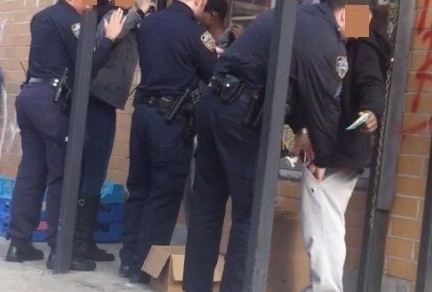
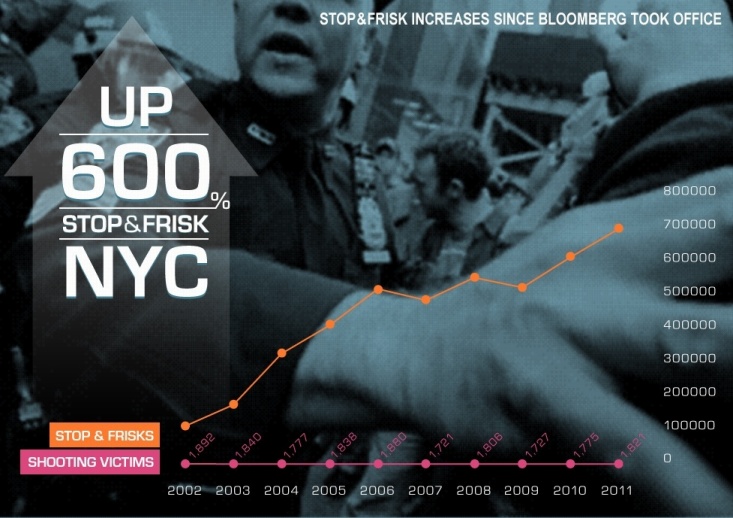
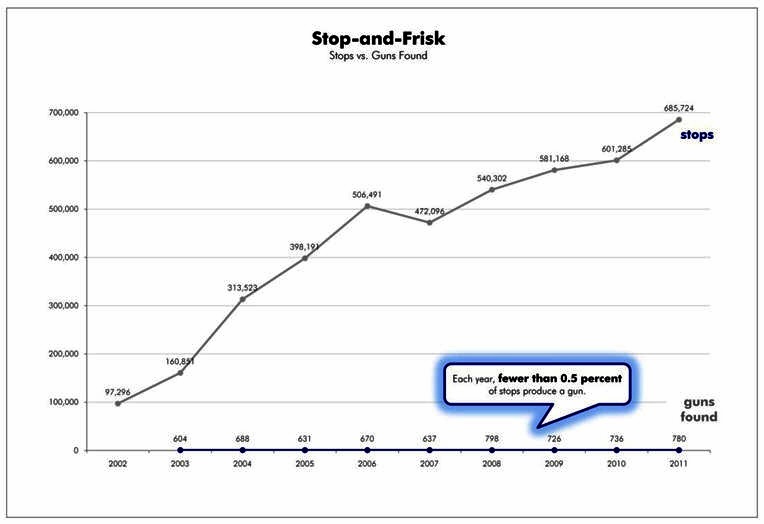
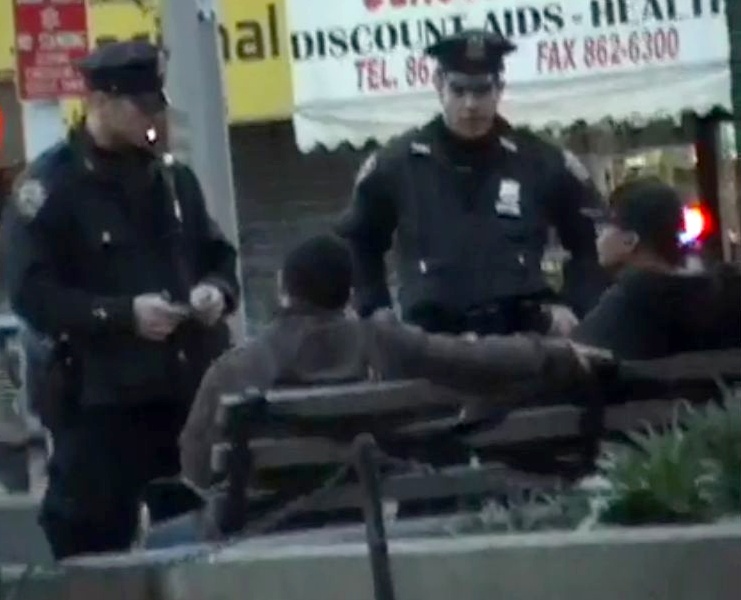
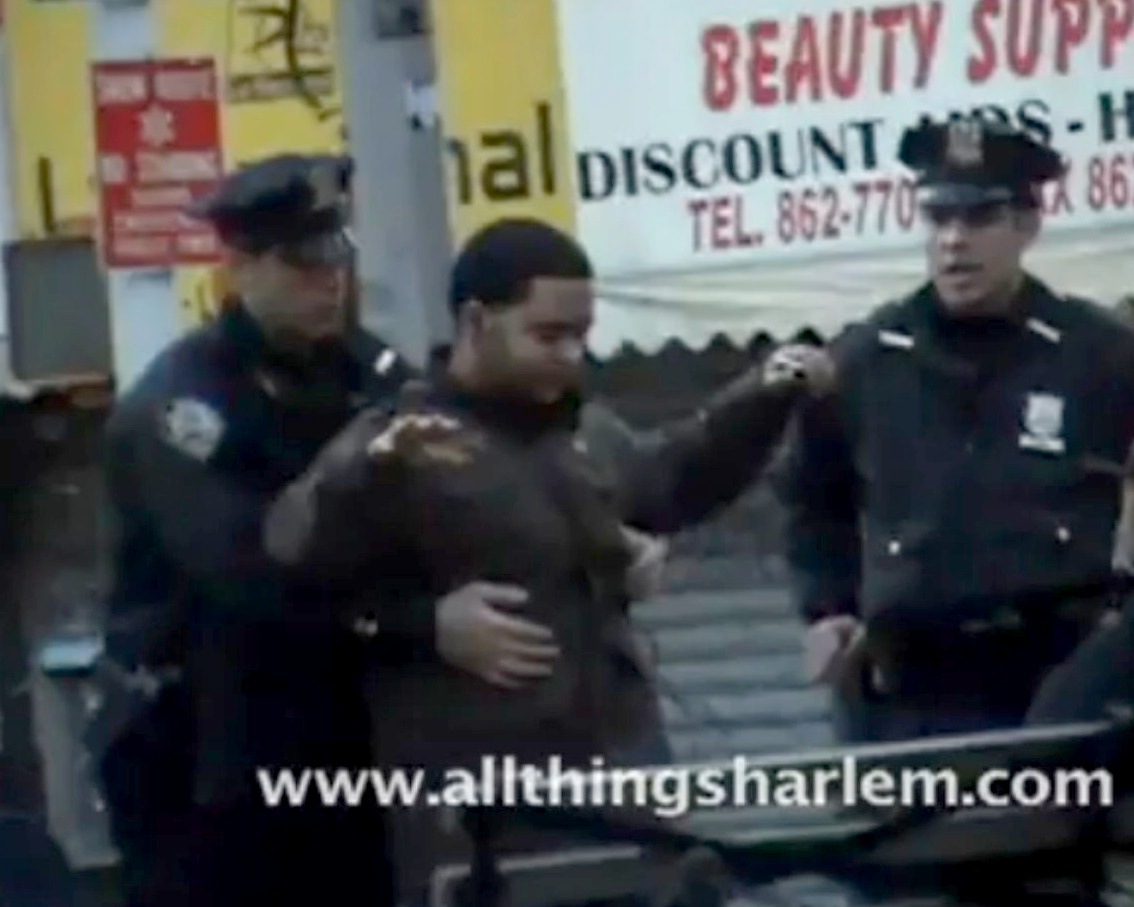
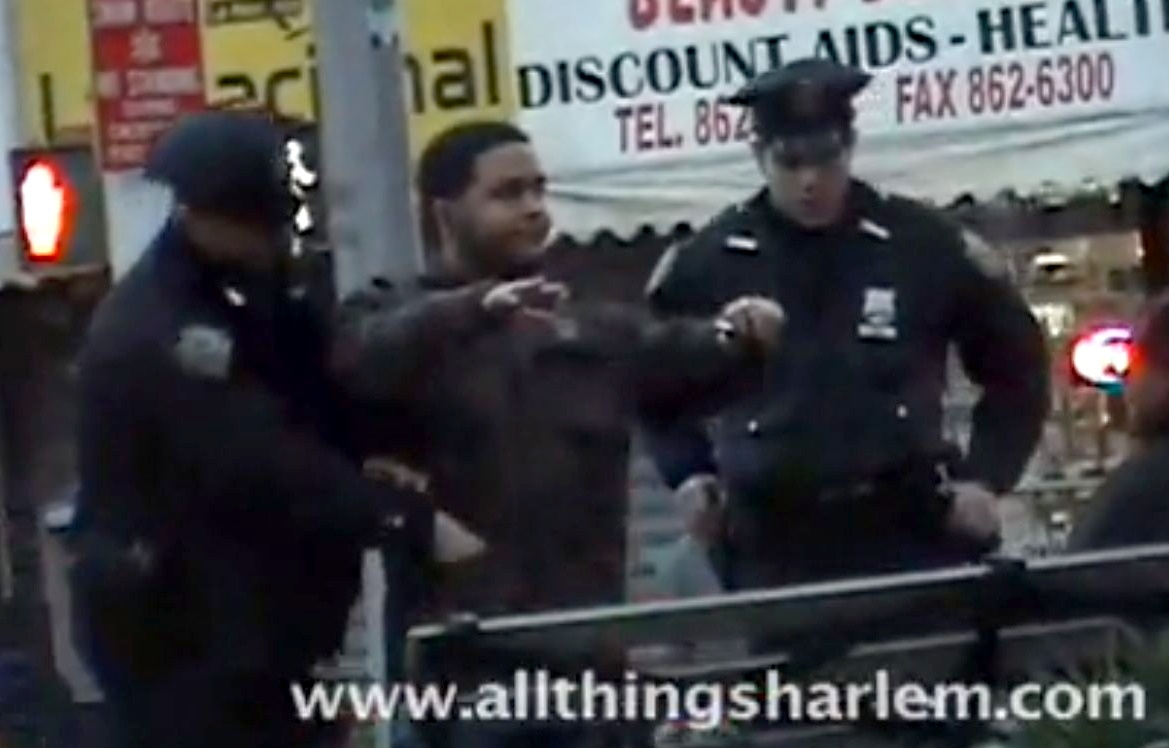
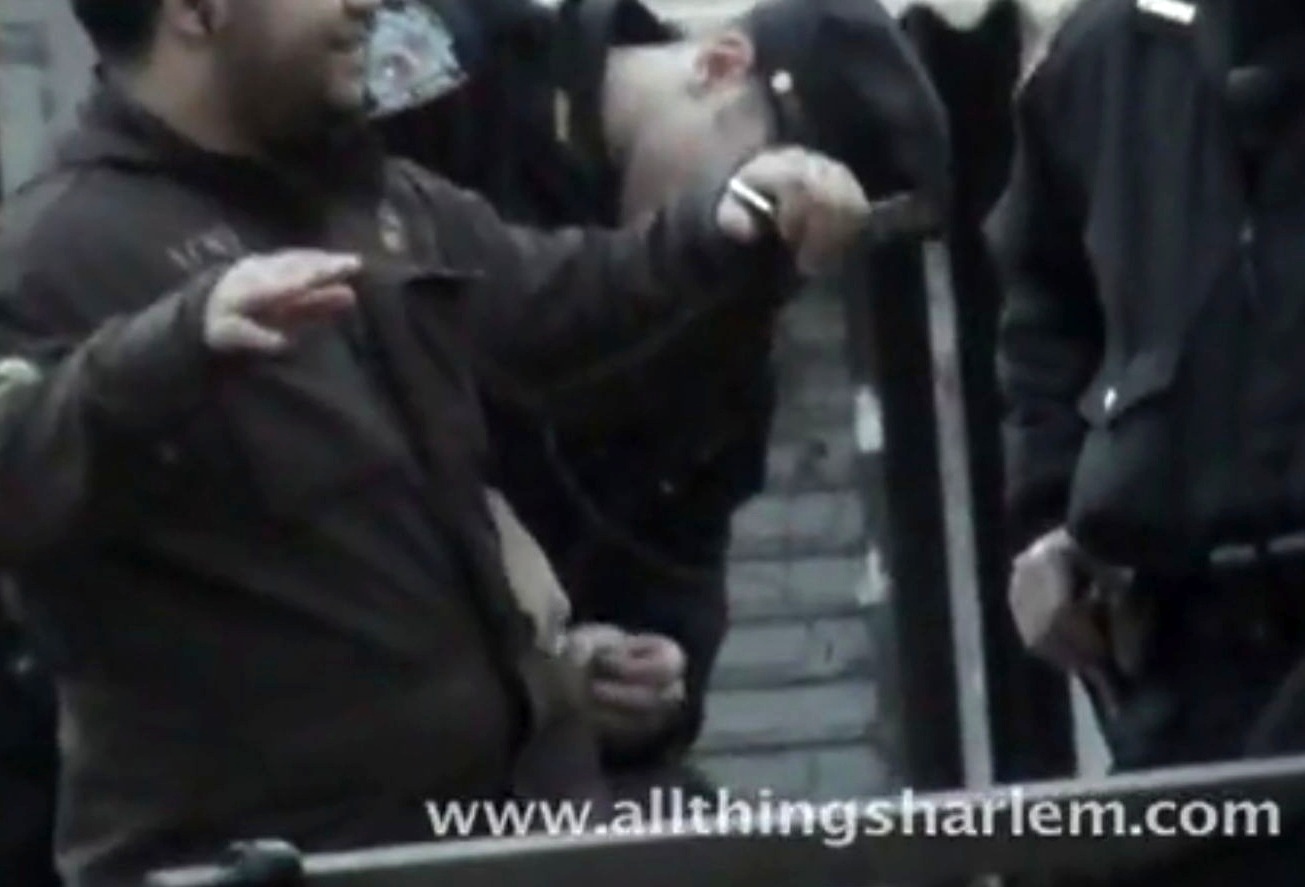
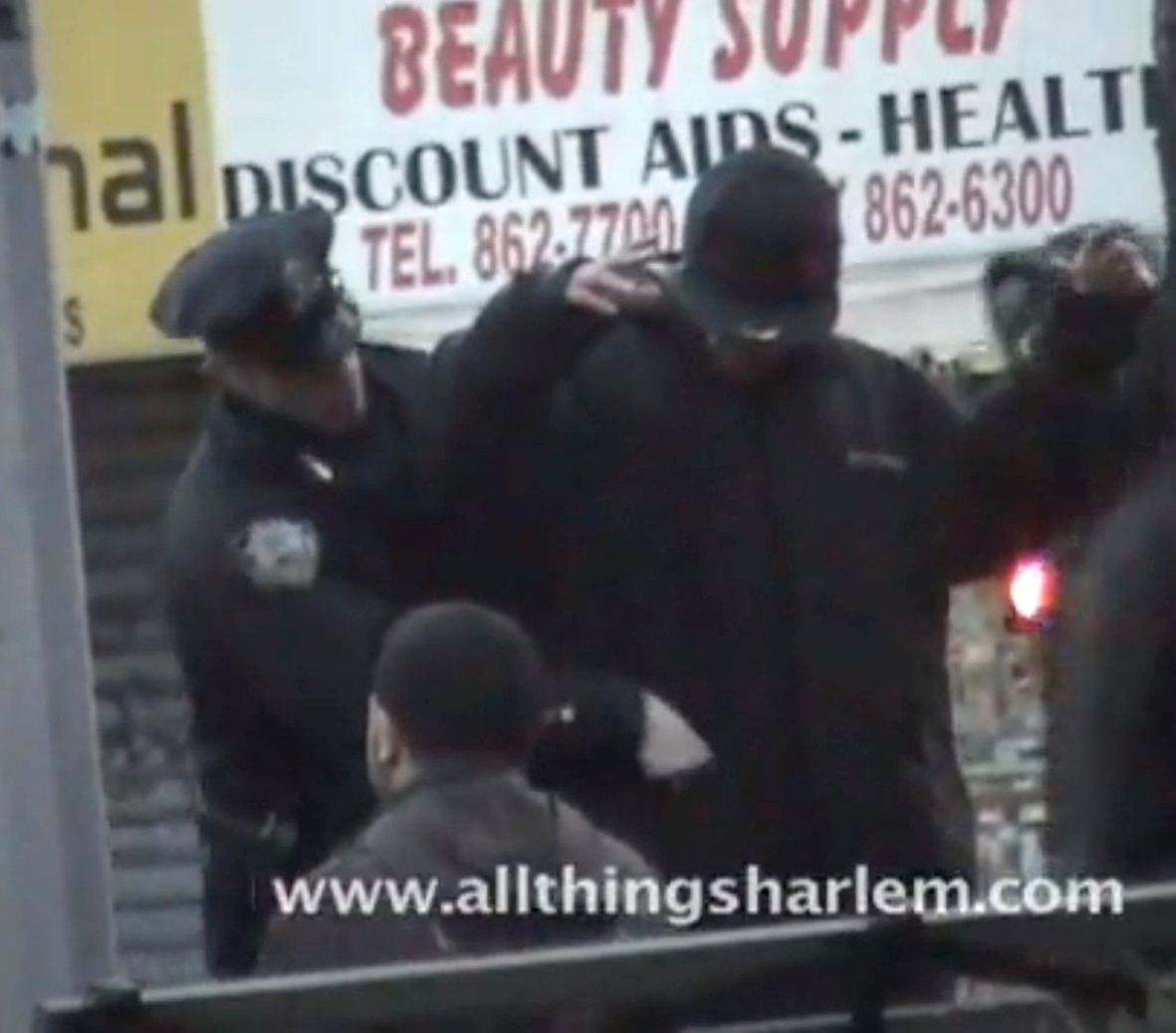
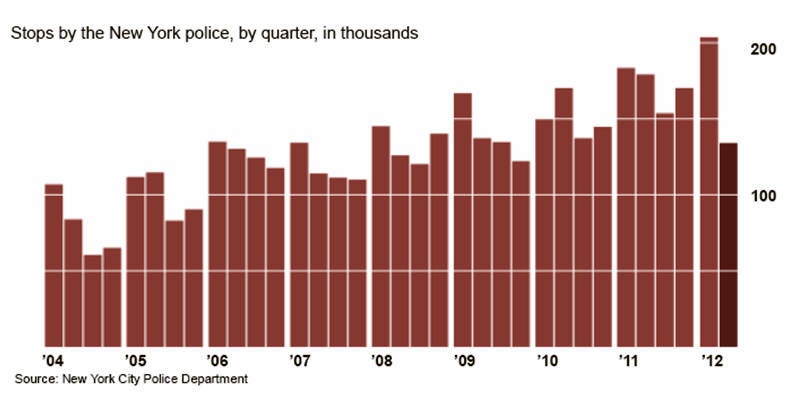
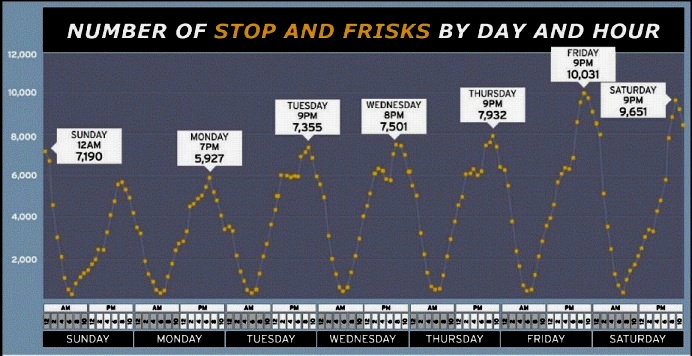
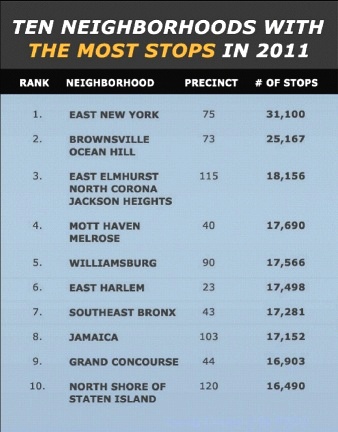
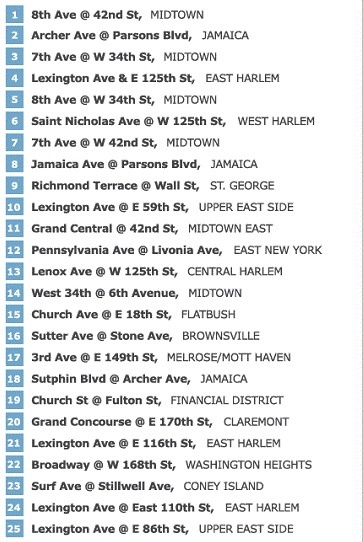
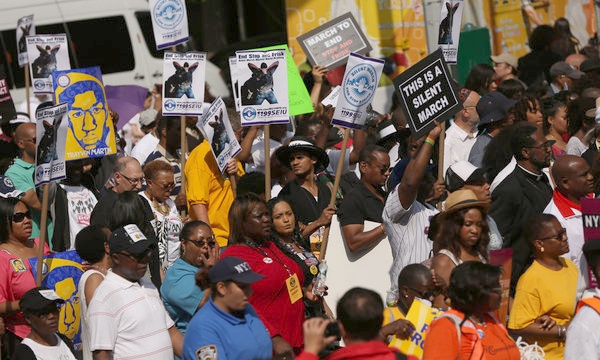
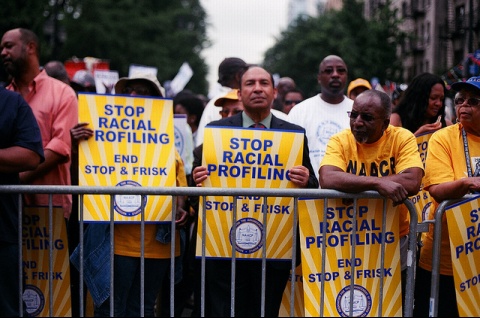
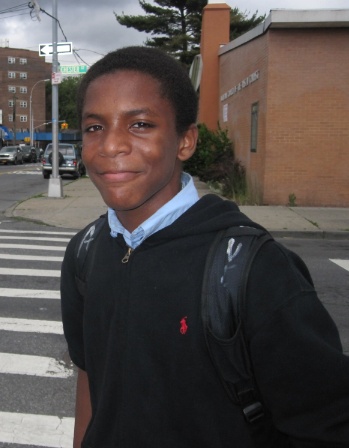
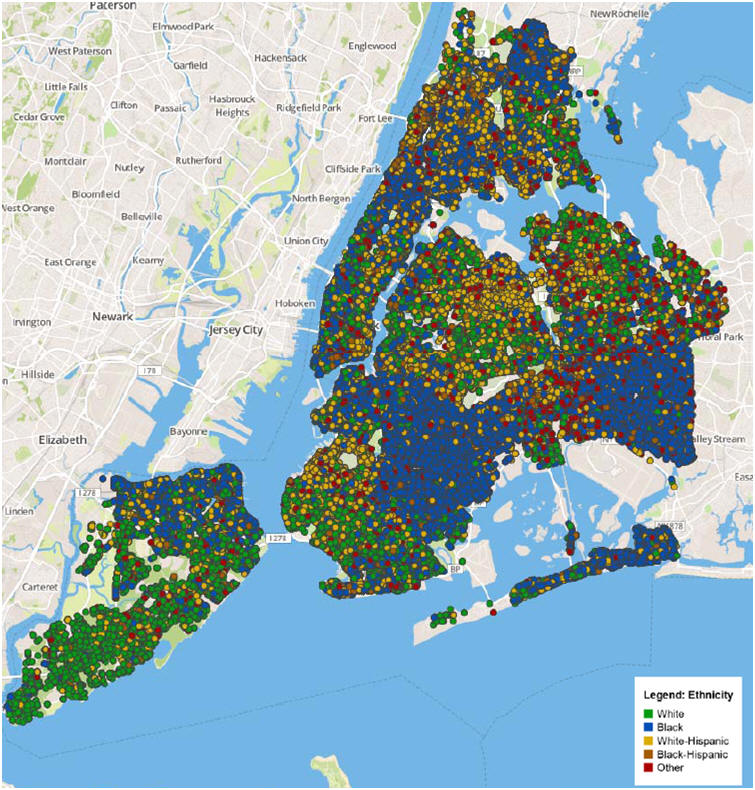
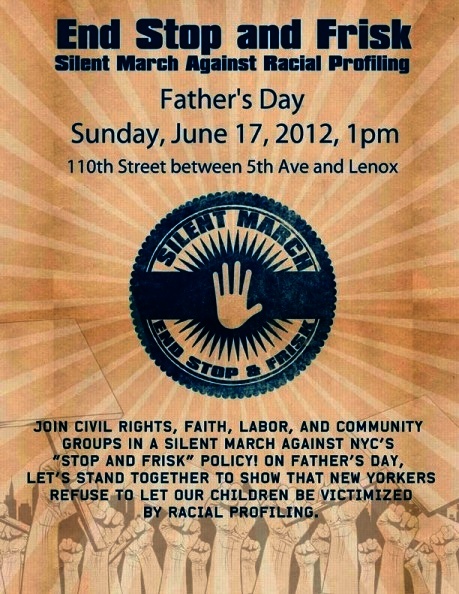
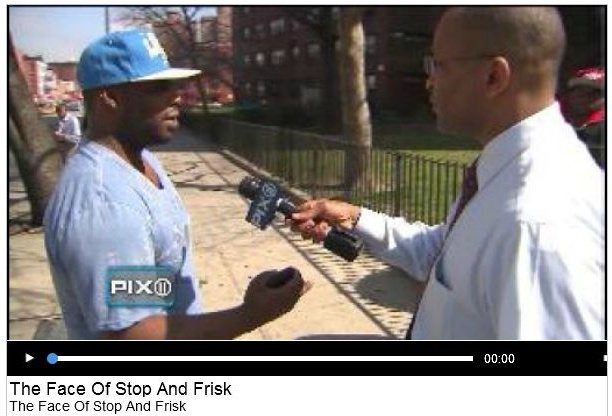
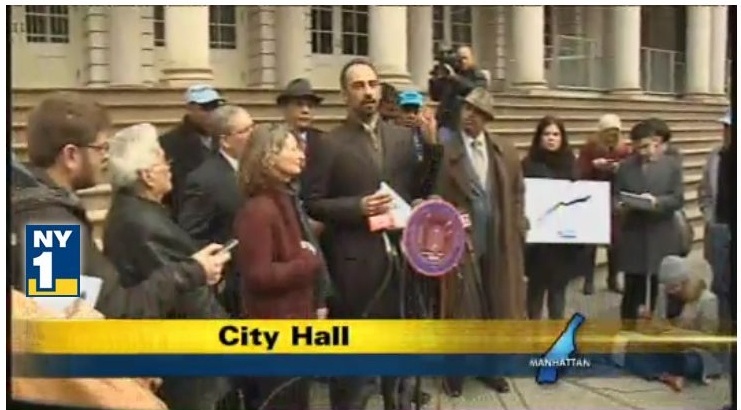
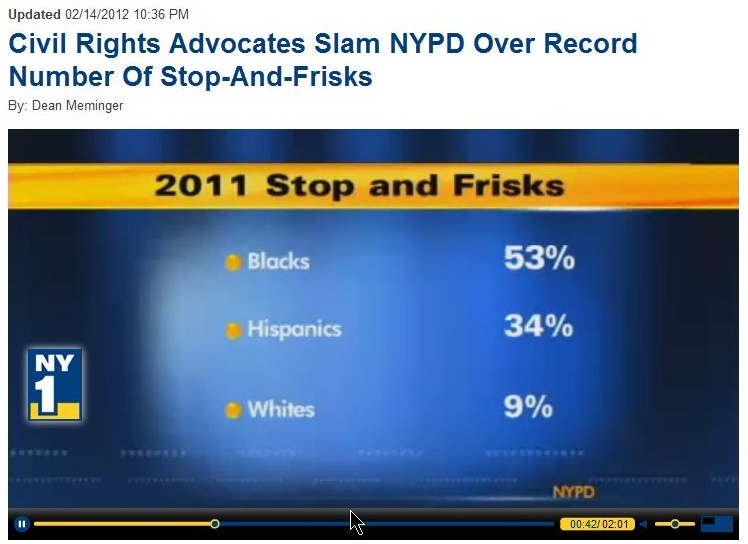
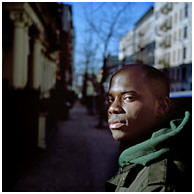 Less
than two years later, in the spring of 2008, N.Y.P.D. officers stopped and
frisked me, again. And for no apparent reason. This time I was leaving my
grandmother’s home in Flatbush, Brooklyn; a squad car passed me as I walked
down East 49th Street to the bus stop. The car backed up. Three officers
jumped out. Not again. The officers ordered me to stand, hands against a
garage door, fished my wallet out of my pocket and looked at my ID.
Then they let me go.
Less
than two years later, in the spring of 2008, N.Y.P.D. officers stopped and
frisked me, again. And for no apparent reason. This time I was leaving my
grandmother’s home in Flatbush, Brooklyn; a squad car passed me as I walked
down East 49th Street to the bus stop. The car backed up. Three officers
jumped out. Not again. The officers ordered me to stand, hands against a
garage door, fished my wallet out of my pocket and looked at my ID.
Then they let me go.