AN ONLINE LIBRARY ABOUT MARIJUANA POSSESSION ARRESTS,
RACE AND POLICE POLICY IN NEW YORK CITY AND BEYOND
|
|
AN ONLINE LIBRARY ABOUT MARIJUANA POSSESSION ARRESTS, RACE AND POLICE POLICY IN NEW YORK CITY AND BEYOND |
|---|
___________________________________________________________________________________________________________________________
|
• OUR REPORTS, PUBLICATIONS, TESTIMONY
•
The Scandal of Racist Marijuana Arrests
• THE AWFUL SUMMONS COURT SYSTEM IN NYC
NY City's Marijuana Possession Arrests __________________________________ __________________________________
Archives: No longer updated but still useful for researchers. • STOP & FRISK REPORTS AND DATA
• STOP & FRISK NYC (news excerpts)
•
POLICE PERJURY AND FALSIFYING: Excerpts
• U.S. MARIJUANA ARRESTS 1965-2013
____________________________________
|
REPORTS, PUBLICATIONS, TESTIMONY
BY THE MARIJUANA ARREST RESEARCH PROJECT __________________________________________________________________________________
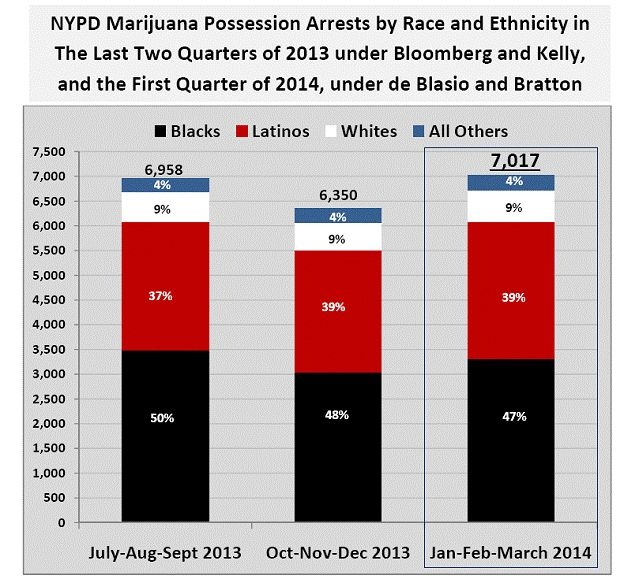
• NYC’s 1.5 Million Arrest Warrants for Non‐Criminal Offences and New York City's Jim Crow Marijuana Arrests: Truth, Race, Hidden Data, and Routine Policing in New York City by Harry Levine, March 2017. Testimony for The U.S. Commission on Civil Right hearing on “Police Practices and Accountabiility in New York City," CUNY School of Law, 2 Court Square, Long Island City, March 21, 2017 RACE, CLASS AND MARIJUANA ARRESTS IN MAYOR DE BLASIO'S TWO NEW YORKS THE NYPD'S MARIJUANA ARREST CRUSADE CONTINUES IN 2014 Data on race, income and arrests in 20 neighbohoods with lowest rates and 20 with the highest rates of marijuana possession arrests. Harry Levine & Loren Siegel, 14 pages, October 2014 {See press coverage here } More of The Same: NYPD Marijuana Arrests in the First Four Months of 2014 -- press release, charts, and docs, 12 pages, June 2014, & NYPD Marijuana Arrests UP in the First Quarter of 2014 -- press release and graphsThe Scandal of Racist Mariuana Arrests by Harry Levine, in The Nation magazine, November 2013 National Disgrace Interview with Harry Levine by Natasha Lennard, The New Inquiry, April 2013
by Harry G. Levine, Loren Siegel, and Gabriel Sayegh, March 2013 Report about police time and resources devoted to making marijuana possession arrests since Bloomberg became Mayor, released by Drug Policy Alliance and The Marijuana Arrest Project. Includes numerous excerpts of responses to NYC's possession arrests from 2007 to 2013. Bloomberg's Marijuana Arrest Crusade is ... Softened? by Harry G. Levine, Alternet.org – February 2013 Short oped about the "reform" announced in the Mayor's State of the City Address Police Stops, Illegal Searches, And Marijuana Possession Arrests Testimony by Harry Levine to Hearings of the New York City Council, October 2012. Marijuana Possession Arrests, Illegal Searches, and The Summons Court System: Testimony by Harry Levine to the New York City Council – June 2012 Regarding proposed legislation with photos of illegal police searches and discussion of the summons court system which will handle the decriminalized marijuana possession charges. In Colorado, 1986-2010 by Harry Levine, Jon Gettman, Loren Siegel, Oct. 2012
•
240,000 Marijuana Possession Arrests:
Costs, Consequences and Racial Disparities of $75 Million A Year: The Cost of New York City's Marijuana Possession Arrests by Harry G. Levine & Loren Siegel – March 2011 Report released with the Drug Policy Alliance about the cost of arresting 50,000 people a year. Regarding Marijuana Arrests: Testimony to the New York State Senate – June 2011 Includes new data showing NYPD arrests by precinct and arrests in 13 counties and cites in NY State Arresting Blacks for Marijuana in California, 2007-2009: Possession Arrests in 25 Cites By Harry G. Levine, Jon Gettman & Loren Siegel. Oct 2010. Report released with California NAACP and the Drug Policy Alliance about arrests of blacks for marijuana possession in 25 California cities where blacks are arrested at 4, 6, 8 and even 12 times the rate of whites. Arresting Latinos for Marijuana in California, 2007-2009: Possession Arrests in 33 Cities. By Harry G. Levine, Jon Gettman & Loren Siegel. Oct 2010.
Report released with William C. Velasquez Institute, a Latino
civil rights organization, about the disproportionate arrests of Latinos for
marijuana possession in 33 Targeting Blacks For Marijuana: Possession Arrests in California, 2004-08
By Harry G. Levine, Jon Gettman
& Loren Siegel, June
2010 The Epidemic of Pot Arrests in New York City, by Harry G. Levine, Alternet.org – Aug 2009 Oped summary of arrests in NYC and other cities. New York City's Marijuana Arrest Crusade ... Continues - 2009 Brief update of the above report with new graphs and data. Sept 2009, updated Jan 2010 Marijuana Arrest Crusade: Racial Bias and Police Policy in New York City, 1997-2007,
by Harry G. Levine & Deborah P. Small.
April 2008
Source: Click here for tables with full source information.
____________________________________________________________________________________________________________________
Marijuana
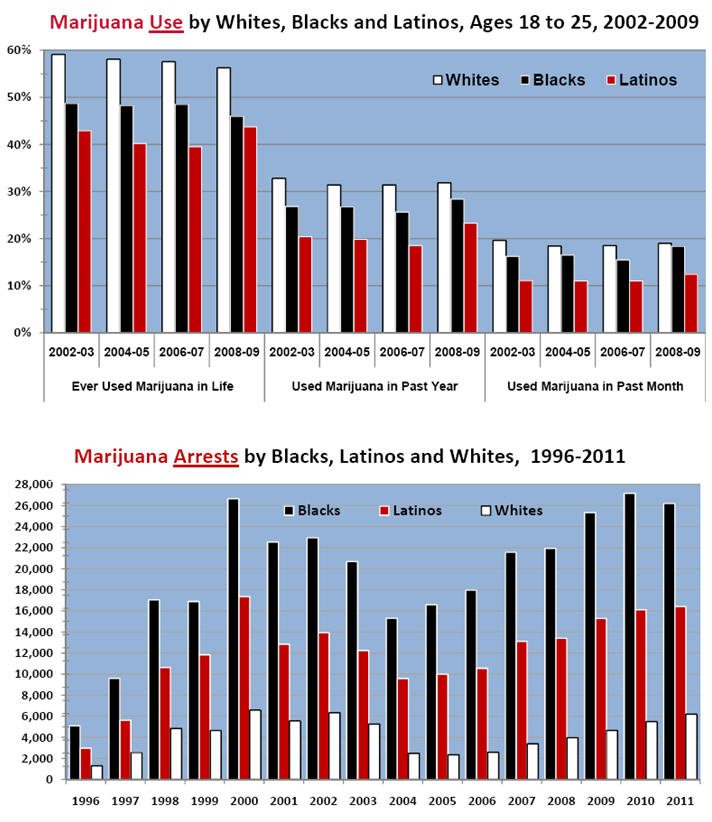
Arrests in New York City • In New York City since 1997, for twenty years, 85% of the people arrested for marijuana possession have been blacks and Latinos. The New York Police Department has arrested blacks for marijuana possession at seven times the rate of whites, and has arrested Latinos at nearly four times the rate of whites. Yet, U.S. government studies have consistently found that young whites use marijuana at higher rates than young blacks or Latinos.
• It has cost New York City up to $75 million dollars a year to arrest and jail people simply for possessing marijuana.
•
Most people arrested for lowest-level marijuana possession in New York City are young: 23% of the
people arrested are
teenagers; 55% are under 25 years of age; and 68% are under 30 years of
age.
• The marijuana arrests target people
who have never been convicted or even arrested before. Of the hundreds of
thousands of people
arrested for marijuana possession in New York City: 30% had never
been arrested before for anything; another 41% had never been convicted or
plead guilty to anything, not even a misdemeanor. Mostly the charges were
dismissed or dropped. In other words, 71% of the people arrested for
marijuana possession had never been convicted of any crime whatsoever.
Another 11% had a previous conviction only for a misdemeanor. • Since 1977 and the passage of the Marijuana Reform Act by the state legislature, the possession of 25 grams or less of marijuana (7/8th of an ounce) has NOT been a crime in New York State. Under New York State law, possession of a less than an ounce of marijuana is a violation, like a traffic violation.
• Most people arrested for marijuana in New York City were not smoking marijuana or did not have marijuana in public view. Most people simply had a small amount buried in their pockets or belongings. Most of the arrests were made as a result of a police stop. Police officers either tricked people into taking out their marijuana, ordered them to do so, or illegally searched their pockets and belongings.
• The marijuana possession arrests do not reduce serious crime or violence, but they are very useful for significant groups within the police department. The arrests are relatively safe and easy, provide training for rookie police, and allow patrol and narcotics officers and their supervisors to meet arrest quotas and make overtime pay. They produce records of police activity and help supervisors keep track of what officers are doing. The arrests are also the most effective way for the NYPD to collect fingerprints, photographs and other information on young people not yet entered in the criminal databases.
•
New York City's racially-biased marijuana arrests are extreme, but they are
not unusual. Large cities and counties throughout the United States arrest
blacks and Latinos for marijuana possession at three, four, five, and up to
ten times or more the rate of whites. Chicago and other major cities arrest blacks at seven
times the rate of whites, just as New York City does.
Along with DNA collection for misdemeanors and other policing policies, this
produces an institutional form of unjust discrimination that some have
termed "racism without racists." The law professor Michelle
Alexander has rightly described this as "the new Jim Crow."
November 11, 2014
|
|---|---|